
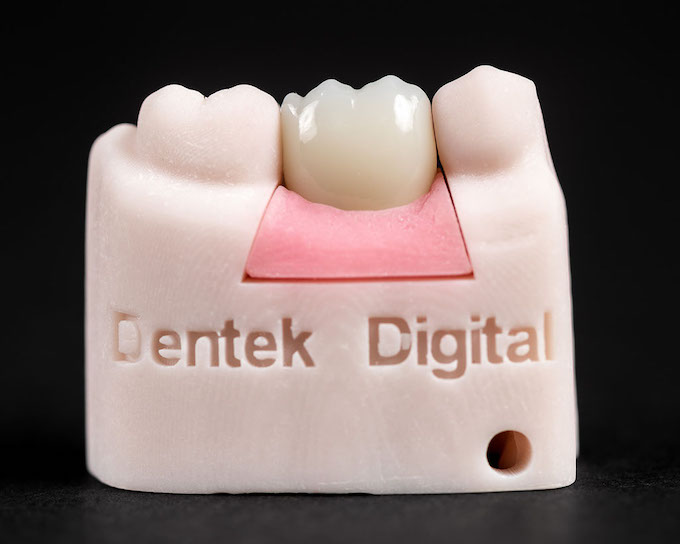
Every successful dental restoration starts with one critical foundation: occlusal design. When a restoration fits the bite correctly, patients experience comfort, function, and longevity. When it does not, the consequences can be significant — from wear and fractures to joint discomfort and patient dissatisfaction.
At Dentek Digital, our CAD/CAM workflow allows us to approach occlusal design with a level of precision that traditional methods simply cannot match. We design every restoration with the entire bite in mind, not just the individual tooth. This makes a real difference for dentists and their patients across the Greater Phoenix area.
In this post, we explore how thoughtful occlusal design improves restoration outcomes. We also share practical insights that dental practices in Phoenix, Scottsdale, Gilbert, and Mesa can apply right away.
What Is Occlusal Design and Why Does It Matter?
Occlusal design refers to the way a restoration’s biting surface is shaped, contoured, and positioned. It determines how upper and lower teeth contact each other during chewing, swallowing, and resting. Therefore, it affects nearly every aspect of how a restoration performs over time.
Poor occlusal design is one of the most common reasons restorations fail early. It can cause uneven force distribution across the teeth. As a result, patients may experience sensitivity, cracking, or TMJ-related discomfort.
Good occlusal design, on the other hand, distributes bite forces evenly. It also works in harmony with the patient’s natural jaw movement. This is the goal every time our team at Dentek Digital opens a new case file.
The Role of Centric Occlusion
Centric occlusion is the position where the teeth come together in maximum contact. It is often called the patient’s “habitual bite.” When designing a restoration, our technicians always consider how the new surface will interact with this position.
A restoration that disrupts centric occlusion — even slightly — can cause the patient’s jaw to shift. Over time, this leads to muscle fatigue and accelerated wear. For this reason, we treat centric occlusion as a non-negotiable reference point in every design.
Excursive Movements and Guidance
Beyond the resting bite, teeth also move laterally and in protrusion. These are called excursive movements. Proper anterior guidance and canine guidance protect posterior teeth from excessive lateral forces.
In our digital workflow, we can simulate these movements during the design phase. This allows us to refine the restoration’s contours before a single block of material is milled. Consequently, chairside adjustments are minimal and predictable.
How CAD/CAM Technology Elevates Occlusal Design
CAD/CAM dentistry has fundamentally changed how dental labs approach occlusal design. Digital tools give technicians far greater control over every surface, cusp angle, and contact point than wax-and-plaster methods ever could.
At Dentek Digital, we were among the earliest adopters of the digital CAD/CAM workflow in the country. Because of this experience, our team has developed deep expertise in designing restorations that meet both aesthetic and functional demands. We serve dentists throughout Chandler, Tempe, Mesa, and the broader Phoenix metro region.
Digital Articulation and Virtual Mounting
One major advantage of digital design is virtual articulation. We can mount digital models and simulate a patient’s bite in full three dimensions. This means we see exactly how the restoration contacts opposing teeth before fabrication begins.
Virtual mounting also allows us to check for interferences early. These are spots where the restoration contacts the opposing arch in an unintended way. Catching interferences at the design stage saves time for the dentist and discomfort for the patient.
Designing to the Anatomy, Not Around It
Our technicians design restorations that mirror natural tooth anatomy. We study cusp-fossa relationships carefully. We also pay close attention to marginal ridges and the depth of developmental grooves.
Furthermore, we use tooth libraries and reference anatomy to guide our designs. This does not replace skilled judgment — it supports it. Every design is reviewed and refined by an experienced technician before it goes to the mill.
Precision Milling and Material Consistency
Even a perfect digital design can be compromised by inconsistent fabrication. Our milling equipment operates with tight tolerances. Additionally, we use high-quality zirconia, lithium disilicate, and other materials known for their dimensional stability.
The result is a restoration that matches the approved design accurately. When the dentist seats the restoration, the occlusal contacts are where we intended them to be. This level of consistency benefits practices across the Greater Phoenix area every day.
Practical Tips for Better Occlusal Outcomes
Occlusal design is a collaboration between the dental lab and the dental practice. When both sides communicate clearly, outcomes improve significantly. Here are some actionable tips for dental practices submitting cases to Dentek Digital.
- Provide accurate bite records. A high-quality bite registration gives our technicians the clearest picture of the patient’s occlusion. The more precise the record, the better the design.
- Mark existing contacts before preparation. Noting where the patient currently contacts helps us understand their occlusal scheme. This context is valuable during design.
- Share photos of the opposing arch. Images of wear patterns, existing restorations, and tooth position help us anticipate potential occlusal challenges.
- Communicate the patient’s history. If the patient bruxes or has a history of chipping restorations, tell us. We can adjust the design and material selection accordingly.
- Request a pre-mill review for complex cases. For full-arch cases or significant occlusal changes, ask our team to review the design before milling. This prevents costly remakes.
These simple steps make a meaningful difference. Moreover, they strengthen the partnership between your practice and our lab. We encourage practices in Scottsdale, Gilbert, and throughout the Valley to adopt these habits consistently.
Occlusal Design for Specific Restoration Types
Different restorations present different occlusal design challenges. Understanding these distinctions helps dental practices set the right expectations and provide the right case information.
Crowns and Bridges
For single crowns, our primary goal is accurate cusp-fossa contact with balanced lateral guidance. For bridges, we must also consider the span and how forces are distributed across multiple abutments. Therefore, pontic occlusion requires particular attention to avoid overloading the supporting teeth.
Implant-Supported Restorations
Implant restorations present a unique challenge. Natural teeth have a small amount of give due to the periodontal ligament. Implants do not. As a result, implant crowns and bridges must be designed with slightly lighter occlusal contacts to account for this difference.
At Dentek Digital, we design implant restorations with this distinction in mind. Our technicians are experienced in implant-supported crowns, bridges, and full-arch solutions. This expertise ensures that implant cases are as functional as they are beautiful.
Removables and Full-Arch Solutions
Full-arch removable cases, including complete and partial dentures, require a comprehensive understanding of balanced occlusion. Here, contacts must work harmoniously across the entire arch. Additionally, the base and tooth position must support stable jaw relationships during function.
Our digital removable workflow applies the same occlusal principles we use for fixed restorations. This ensures consistency and quality across all case types we produce.
Frequently Asked Questions About Occlusal Design
What is the difference between occlusal design and bite adjustment?
Occlusal design happens during the fabrication phase at the dental lab. Bite adjustment is a chairside procedure the dentist performs after seating. Good occlusal design reduces the need for extensive chairside adjustments. However, some minor refinement is always normal after final cementation.
How does a digital lab improve occlusal accuracy compared to a traditional lab?
A digital lab uses virtual articulation, precise milling, and digital tooth libraries to design contacts with greater accuracy. Traditional methods rely more heavily on manual waxing, which introduces more variability. As a result, digital restorations often require fewer adjustments at delivery.
Can Dentek Digital accommodate cases with complex occlusal situations?
Yes. Our team has extensive experience with full-arch rehabilitations, bruxism cases, and implant-supported restorations. We also offer digital implant planning services to support more comprehensive treatment cases. Contact us early in the planning process to discuss your specific needs.
What information should I send with an occlusal design case?
Send accurate digital scans or impressions, bite records, photos of the opposing arch, and any relevant patient history. The more context you provide, the better we can tailor the design to the patient’s individual occlusion.
Does occlusal design affect how long a restoration lasts?
Absolutely. Poor occlusal design accelerates wear, increases fracture risk, and can lead to early restoration failure. Well-designed occlusion distributes bite forces evenly. Therefore, it is one of the most important factors in long-term restoration success.
Partner With Dentek Digital for Precision Occlusal Design
At Dentek Digital, occlusal design is not an afterthought — it is at the core of everything we fabricate. From single crowns to full-arch implant cases, we apply the same disciplined digital approach to every restoration that leaves our Phoenix lab.
We are proud to support dental practices across the Greater Phoenix area, including communities in Mesa, Tempe, Chandler, Scottsdale, and Gilbert. Our team combines advanced CAD/CAM technology with skilled craftsmanship to deliver restorations that look great and function even better.
If you are ready to experience the difference that precision occlusal design makes, we would love to work with you. Contact Dentek Digital today to send us a case or discuss your next restoration with our team.