
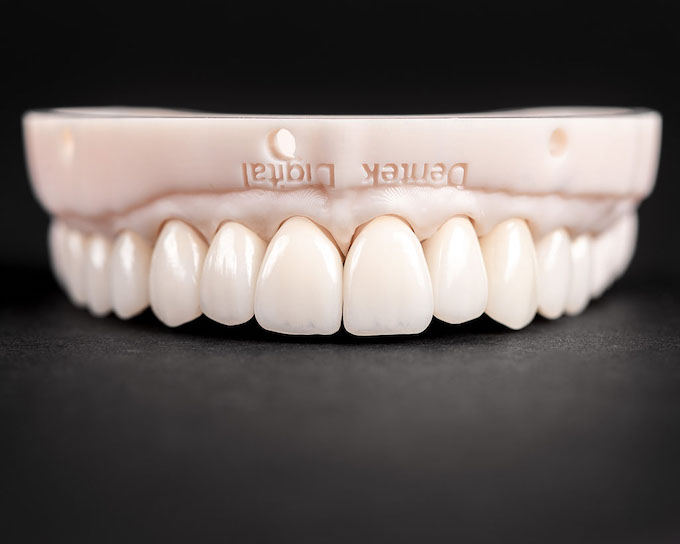
Every dental restoration that comes out of a 3D printer needs to be checked before it reaches a patient. Print validation is the process labs use to confirm that printed components meet precise clinical standards. It is one of the most important steps in the modern digital dentistry workflow.
For dental practices across Phoenix, Mesa, Chandler, and Scottsdale, understanding this process matters. When your lab validates printed parts correctly, you get restorations that fit well and perform reliably. As a result, your patients leave the chair with better outcomes.
At Dentek Digital, print validation is built into every step of our workflow. We combine advanced CAD/CAM dentistry technology with skilled technician oversight to ensure every component is accurate before delivery.
What Is Print Validation in a Dental Lab?
Print validation refers to the series of checks a lab performs on a 3D-printed component. These checks confirm that the part matches the original digital design. They also confirm that the material, dimensions, and surface quality meet clinical requirements.
This is not a single test. Instead, it is a multi-step quality control process. Each step targets a different potential failure point in the printing workflow.
Why Validation Matters for Dental Restorations
3D printing is highly precise. However, small errors can still occur. A printer that is slightly out of calibration can produce parts that are off by a meaningful margin. Furthermore, material inconsistencies or build orientation issues can affect the final fit.
Because of this, labs cannot rely on the printer alone. Human verification and measurement tools are both essential. Together, they catch problems before a restoration ever reaches a dentist’s hands.
Dental practices in Gilbert and Tempe rely on their lab partners to manage this process carefully. A missed validation step can mean a remake, a delayed appointment, or a poor patient experience. Therefore, the validation process deserves serious attention.
Key Steps in the Print Validation Process
While every lab has its own workflow, print validation generally follows a consistent set of steps. Each one serves a specific purpose. Here is how a well-run digital lab approaches this critical stage.
Step 1 — Pre-Print File Review
Validation actually begins before printing starts. A skilled technician reviews the digital design file first. They check for errors in the mesh, confirm margins are clean, and verify that the build orientation is correct.
Build orientation affects how layers are formed during printing. Moreover, it directly influences strength, surface quality, and accuracy. Getting this right at the start prevents many downstream problems.
At Dentek Digital, our team reviews every file carefully before sending it to the printer. This step alone eliminates a large share of potential issues.
Step 2 — Post-Print Dimensional Inspection
Once printing is complete, the component goes through a dimensional inspection. Technicians use precision measurement tools to compare the printed part against the original design. This step confirms that critical dimensions are within acceptable tolerances.
For example, occlusal thickness, margin depth, and contact points are all measured. Additionally, the overall fit on a reference model is evaluated. Any part that falls outside tolerance is flagged for review.
This is one of the most important print validation steps. It directly connects what the software designed to what the printer actually produced.
Step 3 — Surface and Margin Quality Check
Next, technicians inspect the surface quality of the printed component. They look for layer lines that are too visible, surface roughness, or any artifacts left from the printing process.
Margins receive special attention. A clean, well-defined margin is essential for a restoration that seals properly. Therefore, any inconsistency at the margin is grounds for rejection or additional processing.
Labs serving practices across the Phoenix metro area, including communities like Chandler and Mesa, understand that margin quality directly impacts clinical outcomes. There is no room for guesswork here.
Step 4 — Material Verification
Not all printed materials perform the same way. Additionally, different materials require different print settings and post-processing steps. Verification confirms that the correct material was used and that it was processed according to the manufacturer’s protocol.
Post-curing is a common example. Many 3D-printed dental materials require a controlled curing cycle to reach their final mechanical properties. If the curing step is skipped or done incorrectly, the material may be weaker than intended.
At Dentek Digital, we follow strict material handling protocols. This ensures that every printed component delivers the performance that the treating dentist expects.
Step 5 — Fit Verification on the Model
Finally, the printed component is seated on a physical or digital model for fit verification. This step simulates how the restoration will behave in the mouth. It checks for proper seating, occlusal contacts, and interproximal fit.
If adjustments are needed, they are made before the restoration leaves the lab. As a result, the dentist receives a part that is ready to deliver with minimal chairside adjustment.
This is the last line of defense in the print validation process. However, it is just as important as every earlier step.
The Role of Calibration in Reliable Validation
Print validation is only as reliable as the equipment behind it. Printers, scanners, and measurement tools must all be properly calibrated. A lab that skips regular calibration introduces variability that no validation process can fully catch.
Calibration involves running test prints and comparing their output against known reference standards. It also includes checking measurement devices against certified gauges. Moreover, it requires documentation so that any drift is identified quickly.
At Dentek Digital, calibration is treated as a routine and non-negotiable part of our quality system. Dental practices from Scottsdale to Gilbert depend on us for consistency, and calibration is what makes that consistency possible.
How Often Should Calibration Happen?
Calibration frequency depends on print volume, material type, and equipment specifications. Higher-volume labs typically calibrate more often. Additionally, any time a printer is moved, serviced, or has new software installed, recalibration is required.
This is not a once-a-year task. It is an ongoing discipline. Labs that treat it as such deliver more predictable results over time.
Print Validation for Different Types of Restorations
The validation steps described above apply broadly. However, specific restoration types have their own additional requirements. Understanding these helps dentists know what to expect from their lab partner.
Surgical Guides and Implant Components
Surgical guides require an especially high level of print validation. These components guide implant placement, so dimensional accuracy is critical. Even small deviations can affect the surgical outcome.
Furthermore, the fit of a surgical guide on the tissue or bone must be verified carefully. At Dentek Digital, we offer advanced digital implant planning services and apply rigorous validation to every guide we produce.
Splints and Nightguards
Printed splints and nightguards must be validated for both fit and material properties. Additionally, the occlusal surface must be verified to ensure even contact. These devices are worn repeatedly, so durability and comfort both matter.
For dental practices in Tempe and Mesa that prescribe splints frequently, a reliable validation process at the lab level reduces remakes and improves patient satisfaction.
Temporary and Permanent Fixed Restorations
Printed temporaries must fit accurately and feel comfortable while a patient waits for a permanent restoration. Permanent printed crowns and bridges require even tighter tolerances. Therefore, both categories receive thorough validation before leaving our lab.
Ready to simplify your lab workflow? Contact Dentek Digital to discuss your case and learn how our validation process supports better outcomes for your patients.
How Dentek Digital Approaches Print Validation
Dentek Digital was among the earliest adopters of the digital CAD/CAM workflow in the country. Our experience gives us a deep understanding of where printed components can fail — and how to prevent it.
Our team combines advanced technology with skilled craftsmanship. We do not rely on automation alone. Instead, trained technicians are involved at every key validation step. This combination of technology and human expertise is what sets our work apart.
We serve dental practices throughout the Greater Phoenix area, including Scottsdale, Chandler, Gilbert, Mesa, and Tempe. Our goal is to be the lab partner that your practice can count on for precision and reliability, case after case.
Frequently Asked Questions About Print Validation
What does print validation mean in a dental lab?
Print validation is the process of verifying that a 3D-printed dental component meets the required dimensional, material, and clinical standards. It includes multiple inspection steps before the part is delivered to a dentist.
Why can’t labs just trust the printer to be accurate?
Printers are precise tools, but they are not infallible. Calibration drift, material variability, and build orientation can all introduce errors. Therefore, human oversight and measurement tools are essential to catch issues the printer itself cannot detect.
How does validation affect the fit of a dental restoration?
Validation directly affects fit. Dimensional inspection and model-seating checks confirm that the restoration will seat properly in the mouth. As a result, dentists experience fewer adjustments and remakes at delivery appointments.
Does every type of printed component need validation?
Yes. All printed dental components — from surgical guides and splints to crowns and temporaries — require validation. However, the specific steps and tolerances vary based on the clinical application.
How does Dentek Digital handle print validation for my cases?
We apply a multi-step validation process to every case. This includes pre-print file review, dimensional inspection, surface and margin checks, material verification, and model fit testing. Our team in Phoenix handles every step with care and precision.
Partner With a Lab That Takes Validation Seriously
Print validation is not an optional extra. It is a fundamental part of delivering dental restorations that perform as designed. Without it, even the most advanced printer in the world cannot guarantee consistent results.
At Dentek Digital, we have built our reputation on precision and reliability. Dental practices across Phoenix, Scottsdale, Chandler, Mesa, Gilbert, and Tempe trust us to validate every printed component with the same level of care. We combine cutting-edge CAD/CAM technology with experienced technician judgment to deliver results you can count on.
If you are looking for a digital lab partner that understands the importance of print validation, we are ready to work with you. Explore your options and reach out to the Dentek Digital team today to get started.