
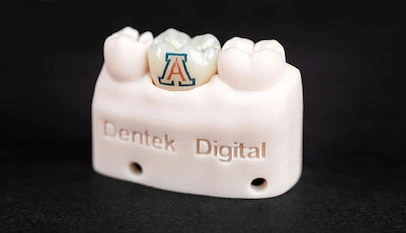
Crown restorations have come a long way. Today, digital crowns offer clinical advantages that traditional methods simply cannot match. Dentists across the Greater Phoenix area are making the shift — and patients are noticing the difference.
At Dentek Digital, we have been at the forefront of the CAD/CAM dentistry revolution since its earliest days. We combine advanced technology with skilled craftsmanship to deliver precise, reliable restorations. Our team partners with dental practices in Phoenix, Scottsdale, Mesa, Chandler, and beyond to support better patient outcomes every day.
In this post, we break down the key clinical advantages of digital crown design. Whether you are a general dentist or a specialist, this information can help you understand why digital workflows are raising the standard of care.
What Makes Digital Crown Design Different?
Traditional crown fabrication relies heavily on physical impressions and manual sculpting. These steps introduce opportunities for error at every stage. Digital crown design removes many of those variables.
With a digital workflow, a dentist captures a precise intraoral scan of the prepared tooth. That data is then sent directly to the lab. As a result, the design process begins with accurate, three-dimensional information from the very start.
The Role of CAD/CAM Technology
CAD/CAM stands for Computer-Aided Design and Computer-Aided Manufacturing. In simple terms, the lab designs the crown digitally and mills it from a solid block of material. This process is highly repeatable and consistent.
Furthermore, digital design software allows lab technicians to visualize the crown from every angle before fabrication begins. Adjustments are made virtually, not physically. This saves both time and material.
Digital vs. Traditional Impressions
Traditional impressions can distort during setting or removal. They can also be uncomfortable for patients. Digital scans, on the other hand, capture the prepared tooth with exceptional accuracy.
Additionally, digital files do not degrade over time. A physical impression can warp or be damaged in transit. A digital file arrives at the lab exactly as it was captured chairside.
Clinical Advantages of Digital Crown Design
There are several strong clinical reasons to choose digital crowns over conventional restorations. Below, we cover the most impactful benefits for both dentists and their patients.
Superior Marginal Fit
Marginal fit is one of the most critical factors in crown success. A poorly fitting margin allows bacteria to infiltrate and can lead to secondary decay. Digital design consistently produces tighter, more accurate margins.
Because the crown is designed from a precise digital scan, the lab technician can refine the margin with a level of detail that is difficult to achieve by hand. Moreover, milling technology removes human variability from the fabrication step entirely.
Dentists in areas like Gilbert and Tempe who send digital cases to our lab regularly report fewer remakes and better seating appointments. That translates directly to saved chair time and improved patient satisfaction.
Improved Occlusal Accuracy
Getting the bite right is essential. An improperly occluding crown causes discomfort, wear, and potential joint problems for patients. Digital design allows technicians to evaluate occlusion virtually before the crown is ever milled.
Additionally, full-arch digital scans capture the patient’s bite relationship in detail. Therefore, the lab has far more information to work with than a traditional stone model provides. The result is a restoration that seats predictably and functions naturally.
Consistent Material Quality
Digital crowns are milled from pre-validated, homogeneous material blocks. This means material quality is consistent from case to case. There are no voids, air bubbles, or inconsistencies introduced during fabrication.
Furthermore, modern milling materials — especially zirconia — are designed for strength and longevity. Zirconia restorations produced through digital workflows are among the most durable options available in dentistry today.
The Zirconia Advantage in Digital Crown Fabrication
Zirconia has become the material of choice for many crown cases, and for good reason. It is extremely strong, biocompatible, and highly aesthetic when designed correctly. Digital workflows and zirconia are a natural pairing.
Strength and Durability
Zirconia is one of the strongest ceramic materials used in restorative dentistry. It resists chipping and fracture better than many alternatives. Because of this, it performs exceptionally well in posterior regions that endure heavy chewing forces.
At Dentek Digital, we fabricate zirconia crowns using a fully digital process from scan to final product. Every step is optimized for accuracy. As a result, dentists in Chandler, Mesa, Scottsdale, and Phoenix can trust that each restoration meets the highest standards.
Aesthetic Precision Through Digital Design
Modern zirconia materials offer translucency levels that closely mimic natural tooth structure. However, achieving a lifelike appearance requires careful design and thoughtful material selection. Digital software allows our technicians to customize each crown’s contour, emergence profile, and shade gradation with precision.
In addition, digital design tools allow for direct comparisons to adjacent natural teeth within the same virtual model. This ensures the final crown blends seamlessly with the patient’s dentition. The outcome is both functionally and aesthetically predictable.
Ready to upgrade your crown workflow? Contact Dentek Digital to discuss your next case and see how our digital lab services can support your practice.
Workflow Efficiency and Practice Benefits
Beyond clinical outcomes, digital crown design also improves workflow efficiency for the entire dental team. Fewer remakes mean fewer patient callbacks. Better-fitting restorations mean shorter delivery appointments.
Faster Turnaround Times
Digital files transfer instantly. There is no waiting for a physical impression to arrive in the mail. As a result, our lab can begin working on a case much sooner than traditional workflows allow.
Moreover, digital fabrication is a streamlined process. Milling and finishing a zirconia crown takes a fraction of the time that traditional hand-building methods require. Dental practices appreciate faster turnaround times because they can serve patients more efficiently.
Reduced Remake Rates
Every remake costs the practice time and money. It also delays treatment for the patient. Digital crown design dramatically reduces the rate of remakes by eliminating common sources of error upfront.
Furthermore, when issues do arise, digital records make communication easier. The lab can review the original scan, the design, and the fabrication data to quickly identify and resolve any problem. This transparency strengthens the dentist-lab partnership.
Better Communication Between Dentist and Lab
Digital workflows enable real communication. Dentists can share photos, notes, and digital scans all in one case submission. Consequently, our technicians have everything they need to produce a restoration that meets the clinical and aesthetic goals of each case.
This collaborative approach is something we take seriously at Dentek Digital. We work closely with practices throughout the Greater Phoenix area to make every case a success. Explore your options and reach out to our team to learn how we can partner with your practice.
Frequently Asked Questions About Digital Crowns
Are digital crowns stronger than traditional crowns?
Digital crowns milled from high-quality zirconia are among the strongest restorations available today. The milling process produces a dense, consistent structure. Additionally, there are no fabrication voids that could weaken the material.
Do I need a special scanner to send digital cases to Dentek Digital?
Most major intraoral scanner brands are compatible with our digital workflow. We work with a wide range of file formats. Contact our team to confirm compatibility with your specific scanner system before submitting your first case.
How accurate is a digital crown compared to one made from a physical impression?
Digital scans consistently deliver high levels of accuracy. Because digital files do not distort or degrade, the data arriving at our lab reflects the actual clinical situation. As a result, marginal fit and occlusal accuracy are reliably excellent.
What types of cases are best suited for digital crowns?
Digital crowns work well for a wide range of restorative cases, including single-unit posteriors, anteriors, and implant-supported crowns. Furthermore, full-arch digital scans make bridge cases and more complex restorative situations highly manageable. We can help you evaluate which cases are the best fit.
How do I get started with Dentek Digital’s digital lab services?
Getting started is simple. Send us your digital scan along with a completed case form, and our team will handle the rest. We serve dental practices throughout Phoenix, Scottsdale, Mesa, Tempe, Gilbert, Chandler, and surrounding communities across Arizona.
Partner with Dentek Digital for Your Crown Cases
Digital crowns represent the future of restorative dentistry — and that future is already here. Dentists who embrace digital workflows consistently report better clinical outcomes, fewer remakes, and more efficient practices. The evidence is clear.
At Dentek Digital, we have been a national leader in digital dentistry since the earliest days of CAD/CAM adoption. We bring that experience to every case we fabricate for dental practices across the Greater Phoenix area. Our team is ready to support your next case with the precision and craftsmanship you expect.
Send us a case today and experience the difference that a truly digital dental lab can make for your patients and your practice.