
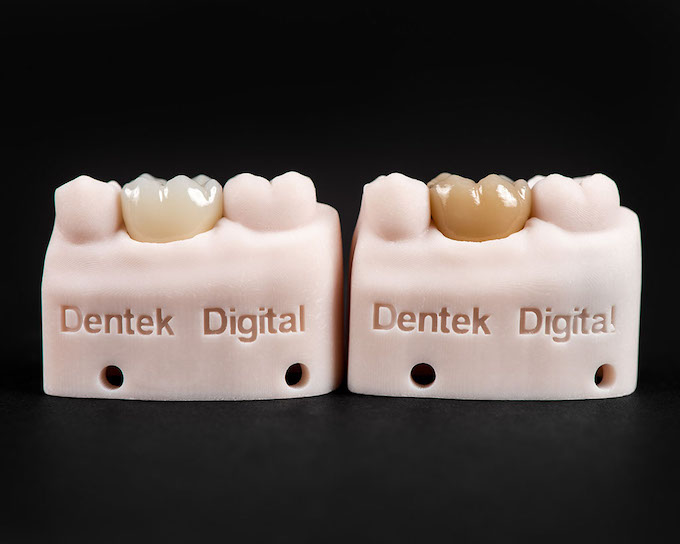
When a patient needs a single-tooth implant restoration, choosing the right retention method matters. Cement retained implant crowns remain one of the most popular and clinically proven options available today. They offer a clean, natural appearance and a secure fit that dentists and patients both appreciate.
At Dentek Digital, we fabricate high-quality cement retained implant crowns using advanced CAD/CAM technology. Our digital workflow allows us to deliver precise, reliable restorations to dental practices across the Greater Phoenix, Arizona area. We work with dentists in Phoenix, Scottsdale, Mesa, Chandler, and beyond.
In this post, we’ll explore what cement retained implant crowns are, how they work, and why digital fabrication makes a significant difference in quality and fit. We’ll also share practical guidance for dental professionals evaluating their implant crown options.
What Are Cement Retained Implant Crowns?
Cement retained implant crowns attach to an implant abutment using dental cement. This approach differs from screw-retained crowns, which use a small screw to secure the restoration directly to the implant body. Both methods have their place in implant dentistry.
However, cement retained designs offer some distinct advantages. They tend to deliver a more natural crown contour and a cleaner occlusal surface. Because there is no screw access hole, the aesthetics are often superior — especially in visible areas of the smile.
How the Cement Retained Design Works
The process starts with a custom abutment or a stock abutment placed on the implant fixture. Next, the crown is fabricated to fit precisely over that abutment. Finally, the dentist cements the crown into place during the delivery appointment.
The cement creates a strong bond between the crown and the abutment. Additionally, the crown sits flush against the gumline for a seamless appearance. When done correctly, the result closely mimics the look and function of a natural tooth.
Common Materials Used
Cement retained implant crowns are most often fabricated from high-strength zirconia or lithium disilicate. Both materials offer excellent aesthetics and long-term durability. At Dentek Digital, we work with premium-grade materials to ensure every restoration meets the highest standards.
Furthermore, our digital milling process ensures precise margins and consistent surface quality. This helps reduce chair time for dentists and improves outcomes for patients. The result is a restoration that fits well, looks natural, and performs reliably.
Why Cement Retained Crowns Are Still a Top Choice
Some clinicians have moved exclusively toward screw-retained implant crowns in recent years. However, cement retained implant crowns continue to be a preferred solution in many clinical situations. Understanding when to use each approach is key.
For example, cement retention works especially well when the implant angulation makes screw access difficult. It also performs well in posterior sites where aesthetics are less critical but function is paramount. In addition, many dentists find cement retained designs easier to restore in terms of workflow.
Aesthetic Advantages
One of the strongest arguments for cement retained implant crowns is aesthetics. Because the occlusal surface has no access hole, the crown looks just like a natural tooth. This is particularly important for anterior restorations in visible smile zones.
Moreover, the crown contours can be shaped more freely without the constraint of a screw channel. As a result, the lab has more flexibility to create ideal emergence profiles. This helps the restoration blend naturally with adjacent teeth and soft tissue.
Functional Reliability
Cement retained implant crowns also offer strong functional performance. The cemented interface distributes occlusal forces evenly across the abutment. Therefore, the restoration can handle normal biting and chewing loads with confidence.
Additionally, modern dental cements provide excellent retention strength. The crown stays firmly in place through everyday function. For most patients, a well-made cement retained crown delivers years of reliable service.
The Role of Digital Fabrication in Implant Crown Quality
Not all implant crowns are created equal. The quality of the final restoration depends heavily on the fabrication process. At Dentek Digital, we use state-of-the-art CAD/CAM technology to mill every crown with exceptional precision.
Our digital workflow begins with a high-resolution scan of the case. Then, our technicians design the crown digitally using advanced software. Finally, the crown is milled from a solid block of premium material for optimal strength and fit.
CAD/CAM Technology Explained
CAD/CAM stands for Computer-Aided Design and Computer-Aided Manufacturing. In simple terms, it means we use computers and milling machines to design and fabricate restorations. This eliminates much of the variability associated with traditional hand-fabrication methods.
Because of this, CAD/CAM-produced crowns tend to have more consistent margins and smoother internal surfaces. As a result, they seat more accurately and require less adjustment at delivery. Dentists in Phoenix, Gilbert, Tempe, and Scottsdale rely on our digital workflow for exactly this reason.
Digital Scanning and Design Precision
The accuracy of a cement retained implant crown starts with the impression or scan. We accept both traditional impressions and digital scan files. However, digital scans offer faster turnaround and reduce the risk of impression distortion.
Once we receive the case, our skilled technicians review the design carefully. They consider the adjacent teeth, the opposing arch, and the soft tissue profile. This attention to detail ensures a restoration that fits, functions, and looks exceptional.
Cement Retained vs. Screw Retained: A Quick Comparison
Dental professionals often ask us to compare cement and screw-retained options. Both have clinical merit. The right choice depends on the specific case and the dentist’s preference.
On the other hand, screw-retained crowns offer retrievability without damaging the restoration. They also eliminate concerns about excess cement around the implant. However, they require favorable implant angulation and result in an access hole in the crown.
- Cement Retained: Superior aesthetics, no access hole, works well with angled implants, easier crown fabrication
- Screw Retained: Fully retrievable, no cement risk, ideal for straight implant angulation
- Both Options: Available in high-strength zirconia and other premium materials from Dentek Digital
Ultimately, the best decision is a clinical one made by the treating dentist. Meanwhile, our team is here to support whichever approach you choose. We fabricate both types to the same high standard of quality.
Practical Tips for Dentists Ordering Cement Retained Implant Crowns
If you’re ordering cement retained implant crowns from a digital lab, a few best practices can help ensure the best outcome. These tips apply whether you’re in downtown Phoenix, Chandler, or anywhere across the Greater Phoenix metro.
Provide Accurate Impressions or Scans
The quality of your impression or scan directly impacts the fit of the final crown. Use a well-fitting implant impression coping and verify the transfer before sending. Additionally, digital scans should capture full arch detail with clear margins around the abutment.
Furthermore, include clear photos when possible. Shade photos, profile shots, and intraoral images all help our technicians make informed design decisions. The more information you send, the better we can serve your case.
Choose the Right Abutment
The abutment selection plays a major role in the final result. A properly designed abutment creates the right emergence profile and supports ideal crown contours. In some cases, a custom abutment is a better choice than a stock option.
Our team can advise on abutment selection based on the case details you provide. Therefore, don’t hesitate to reach out before submitting a complex case. We’re here to collaborate and help you achieve the best possible outcome for your patient.
Specify Cement Space and Margin Design
When submitting your case, indicate your preferred cement space and margin style. These specifications affect how the crown seats and how the cement behaves at delivery. Additionally, let us know your preferred cement type if it influences the internal design.
Clear case notes help us match the crown design to your clinical protocol. As a result, you spend less time adjusting and more time focusing on the patient. That’s the kind of efficiency that makes a real difference in a busy practice.
Why Dental Practices Choose Dentek Digital
Dentek Digital has built a reputation as a national leader in digital dentistry. We were among the first dental labs in the country to adopt a fully digital CAD/CAM workflow. That experience gives us a depth of knowledge that newer labs simply haven’t developed yet.
We serve dental practices throughout the Greater Phoenix area, including Scottsdale, Mesa, Tempe, Chandler, and Gilbert. Our solutions include fixed restorations, removables, splints and nightguards, and dental implant restorations. We also offer advanced services like TattooTH and digital implant planning.
Moreover, our team combines technology with skilled craftsmanship. Every restoration goes through a thorough quality review before it leaves our lab. We take pride in delivering work that dentists can trust and patients can feel confident wearing.
Frequently Asked Questions About Cement Retained Implant Crowns
What is the main advantage of a cement retained implant crown?
The primary advantage is aesthetics. Because there is no screw access hole, the crown looks more like a natural tooth. This makes cement retained implant crowns especially popular for anterior restorations.
Can cement retained crowns be removed if needed?
Yes, but retrieval can be more challenging than with screw-retained crowns. The dentist may need to section the crown to remove it. Therefore, this option works best in cases where long-term retrievability is not a top priority.
Is excess cement a concern with cement retained implant crowns?
Excess cement can cause peri-implant complications if it remains subgingivally. However, proper technique minimizes this risk. Using a try-in without cement first, and carefully removing all excess during cementation, helps prevent issues.
What materials does Dentek Digital use for cement retained implant crowns?
We primarily use high-strength zirconia and lithium disilicate. Both materials offer excellent strength, aesthetics, and long-term durability. Our team can help you choose the best material based on the clinical situation.
How do I submit a cement retained implant crown case to Dentek Digital?
You can submit cases digitally or by sending traditional impressions. We accept digital scan files from all major intraoral scanner platforms. Additionally, we provide clear case submission guidelines to make the process as simple as possible.
Partner with Dentek Digital for Your Implant Crown Cases
Cement retained implant crowns are a trusted, time-tested solution for implant restorations. When they’re designed and fabricated with precision, the results speak for themselves. At Dentek Digital, we combine advanced CAD/CAM technology with deep clinical knowledge to deliver outstanding restorations.
Whether you practice in Phoenix, Scottsdale, Mesa, Tempe, or anywhere across the Greater Phoenix area, we’re here to support your implant cases. Our team is responsive, knowledgeable, and committed to your success.
Ready to elevate your implant restoration workflow? Contact Dentek Digital today to send us a case or request a consultation. We look forward to partnering with your practice.