The dental industry is evolving fast. Dental printing trends are reshaping how labs fabricate restorations and how dentists deliver care. Practices across Phoenix, Scottsdale, and beyond are taking notice.
3D printing is no longer a futuristic concept. It is an active part of modern digital dental workflows today. Therefore, staying informed helps you make smarter decisions for your patients and your practice.
At Dentek Digital, we work at the forefront of digital dentistry. We help dentists across the Greater Phoenix area embrace these advancements with confidence. In this post, we break down the most important trends you should understand right now.
Why 3D Printing Is Changing Dental Labs
Traditional dental fabrication relied heavily on manual processes. However, digital workflows have transformed what is possible. 3D printing allows labs to produce restorations with remarkable precision and consistency.
CAD/CAM dentistry laid the foundation for this shift. It introduced computer-aided design and manufacturing into everyday lab work. As a result, 3D printing became a natural next step in that evolution.
Dentek Digital was one of the earliest adopters of the digital CAD/CAM workflow in the country. We understand how these tools work together. Moreover, we know how to apply them to produce the highest quality restorations available today.
Speed Without Sacrificing Quality
One of the biggest advantages of 3D printing is turnaround time. Digital fabrication moves significantly faster than traditional methods. Because of this, dentists can reduce patient wait times and improve overall satisfaction.
Speed does not mean cutting corners. Advanced 3D printers deliver consistent accuracy across each case. Furthermore, digital files can be reviewed and adjusted before a single layer is printed.
Reproducibility and Accuracy
Accuracy is everything in dental lab work. 3D printing produces highly reproducible results from digital scans. Additionally, digital records make it easier to reprint or modify a case when needed.
This level of precision benefits dentists in Mesa, Chandler, and across the Valley. It means fewer remakes and more predictable outcomes. That is a win for both the practice and the patient.
Key Dental Printing Trends Shaping the Industry
The pace of innovation in 3D printing is accelerating. New materials, new machines, and new workflows are entering the market regularly. Here are the most important dental printing trends to watch.
1. Expanded Material Options
Early 3D printing in dentistry was limited to a narrow range of materials. Today, that has changed significantly. Labs now print with resins, ceramics, and hybrid materials suited for a wide range of applications.
These materials support everything from surgical guides to full-arch restorations. Additionally, new biocompatible resins have expanded printing into areas like nightguards and splints. The options continue to grow each year.
2. Printable Dentures and Removables
Removable prosthodontics has seen a major shift with 3D printing. Printed denture bases and teeth are becoming increasingly refined. Moreover, digital workflows make it easier to archive and reproduce cases.
For practices in Gilbert and Tempe, this means faster removable cases with better fit. Digital dentures reduce the number of try-in appointments needed. Therefore, both the dentist and the patient benefit from a smoother process.
3. Implant Planning and Surgical Guides
3D printing plays a critical role in implant dentistry today. Printed surgical guides allow dentists to place implants with greater accuracy. As a result, procedures become more predictable and less invasive.
Dentek Digital offers advanced digital implant planning services. We work with dentists to design and print guides that support precise placement. This technology is especially valuable for complex full-arch implant cases.
4. Same-Day and In-Office Printing
Some practices are now investing in chairside 3D printers. These units allow for limited in-office fabrication of certain items. However, complex restorations still require the precision and expertise of a certified digital lab.
In-office printing works well for temporaries and certain tray components. On the other hand, final restorations demand the materials, calibration, and finishing that only a professional lab can provide. Partnering with Dentek Digital gives you both speed and quality.
5. Integration with Digital Scanning
3D printing is most powerful when paired with digital scanning. Intraoral scanners capture accurate impressions without the mess of traditional materials. Next, those scans feed directly into CAD software and then to the printer.
This end-to-end digital workflow reduces errors at every step. Furthermore, it creates a seamless communication channel between your practice and your lab. Practices across Scottsdale and Mesa are already adopting this integrated approach.
How These Trends Apply to Your Practice
Understanding these trends is one thing. Knowing how to apply them is another. Here are some practical ways Phoenix-area dentists can leverage 3D printing advancements.
- Audit your current workflow. Identify where traditional processes are slowing you down.
- Talk to your lab. Ask what digital options are available for your most common case types.
- Start with one category. Consider beginning with surgical guides or nightguards before expanding.
- Invest in a quality intraoral scanner. Digital scanning is the first step toward a fully digital workflow.
- Partner with a proven digital lab. Choose a lab with a track record in digital fabrication and CAD/CAM technology.
Dentek Digital partners with dental practices to support this transition. We bring deep expertise in digital workflows and a commitment to exceptional results. Contact Dentek Digital to explore how we can support your next case.
3D Printing and Specialty Dental Services
Beyond standard restorations, 3D printing is expanding into specialty areas. These applications are opening new possibilities for both general dentists and specialists.
TattooTH and Custom Appliances
Dentek Digital offers TattooTH, an innovative service that applies custom artwork to dental appliances. This is made possible in part through precise digital fabrication. Additionally, printed bases provide a consistent canvas for this kind of creative customization.
Custom appliances like splints and nightguards also benefit from 3D printing. Digital fabrication ensures a precise, comfortable fit every time. Furthermore, the turnaround for these cases is faster than traditional methods.
Fixed Restorations and Crowns
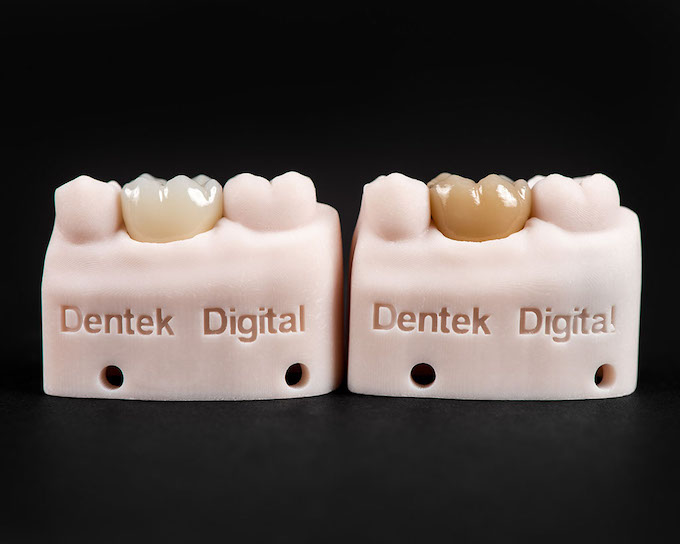
3D printing supports the fabrication of high-quality fixed restorations. Printed models and frameworks form the foundation for crowns, bridges, and veneers. As a result, the final product is built on an accurate and reliable base.
Dentek Digital uses advanced materials and milling alongside printing for fixed cases. This combination delivers the strength and aesthetics that patients expect. Moreover, our quality control process ensures every restoration meets a high standard before it leaves the lab.
Frequently Asked Questions About Dental 3D Printing
Is 3D printing accurate enough for dental restorations?
Yes, modern dental 3D printers produce highly accurate results. When paired with quality digital scans and proper lab protocols, the outcomes are precise and reliable. However, proper calibration and material selection are essential to achieving the best fit.
What types of restorations can be 3D printed?
Many case types benefit from 3D printing today. These include surgical guides, printed models, denture bases, nightguards, splints, and certain frameworks. Additionally, some labs use printing in combination with milling for fixed restorations.
Do I need special equipment to send digital cases to a lab?
An intraoral scanner is the most important tool for sending digital cases. Most modern scanners export files in formats that labs like Dentek Digital can accept. Therefore, if you already have a scanner, you may be ready to start digital submissions today.
How do I know if my lab uses quality 3D printing technology?
Ask your lab about their equipment, materials, and quality control process. A reputable digital lab should be transparent about their workflow. Furthermore, look for a lab with an established track record in digital fabrication and CAD/CAM technology.
Can small practices in Phoenix benefit from 3D printing trends?
Absolutely. Practices of all sizes across Phoenix, Chandler, Gilbert, and the surrounding area can benefit. You do not need to invest in your own printer to take advantage of these trends. Partnering with a digital lab like Dentek Digital gives your practice access to the latest technology without the overhead.
Partner with a Digital Lab That Leads the Way
The dental printing trends shaping the industry today are only going to accelerate. Staying informed and working with the right partners puts your practice in a strong position. Therefore, now is the time to evaluate your workflow and explore what digital fabrication can do for you.
Dentek Digital is recognized as a national leader in digital dentistry. We serve dental practices across the Greater Phoenix area, including Scottsdale, Mesa, Tempe, Chandler, and Gilbert. Our team combines advanced technology with skilled craftsmanship to deliver restorations you can trust.
Whether you are exploring 3D-printed surgical guides, digital dentures, or complex implant cases, we are here to help. Reach out to the Dentek Digital team to discuss your case and find out how our digital solutions can support your practice and your patients.