
Permanent dental implants have transformed the way dentists restore missing teeth. They offer a durable, natural-looking solution that patients and dental professionals trust. Additionally, advances in digital dentistry have made the fabrication process more precise than ever before.
At Dentek Digital, we support dentists across the Greater Phoenix, Arizona area with industry-leading CAD/CAM dental restorations. Our lab combines cutting-edge technology with skilled craftsmanship. Because of this, we consistently deliver implant components that meet the highest standards of fit and quality.
Whether you practice in Scottsdale, Chandler, Mesa, or Gilbert, understanding how permanent implants are designed and fabricated can help you serve your patients better. Therefore, this guide walks through everything you need to know about the digital workflow behind implant restorations.
What Are Permanent Dental Implants?
Permanent dental implants are titanium posts surgically placed into the jawbone. They act as artificial tooth roots. On top of each post, a dental crown or restoration is secured to replace the visible tooth.
Unlike removable dentures, implants are fixed in place. As a result, patients experience a stable, comfortable bite that functions like natural teeth. Furthermore, they help preserve jawbone density over time.
The restoration placed on the implant — the crown, bridge, or full-arch prosthetic — is where the dental lab plays a critical role. That component must be fabricated with exceptional precision. Even slight inaccuracies can compromise the fit, function, and longevity of the final result.
Types of Implant Restorations
Dental implant restorations come in several forms. Each one serves a different clinical need. Here are the most common types:
- Single-unit implant crowns — Used to replace one missing tooth
- Implant-supported bridges — Span multiple missing teeth using two or more implants
- Full-arch restorations — Replace an entire arch of teeth, often called All-on-X solutions
- Implant-retained overdentures — Removable prosthetics that snap onto implant attachments
Each restoration type requires precise design and fabrication. Moreover, the materials and methods used directly affect patient outcomes. Our team at Dentek Digital fabricates all of these restoration types using advanced CAD/CAM technology.
How CAD/CAM Technology Elevates Implant Restorations
CAD/CAM stands for Computer-Aided Design and Computer-Aided Manufacturing. In dental lab terms, it means we use digital software to design restorations and milling machines to fabricate them. This process replaces older, manual methods.
Dentek Digital was one of the earliest adopters of the digital CAD/CAM workflow in the country. Because of this early investment, our team has developed deep expertise in digital implant fabrication. We bring that expertise to every case we receive.
The benefits of the CAD/CAM workflow are significant. First, digital designs are highly accurate and fully reproducible. Next, milled restorations fit better and require fewer adjustments chairside. Finally, the entire process is faster, which means shorter turnaround times for your practice.
Digital Scanning and Case Submission
The CAD/CAM workflow starts with a digital scan. Dentists in areas like Tempe, Mesa, and Chandler send us digital impressions taken with an intraoral scanner. These scans replace traditional physical impressions.
Digital files are far more accurate than conventional impressions. Additionally, they eliminate distortion and shrinkage that can occur with traditional materials. As a result, the restorations we design from these files fit better from the start.
Once we receive a digital case file, our technicians review the scan carefully. We check occlusion, margins, and implant angulation before designing the restoration. This thorough review process helps us catch potential issues early.
Material Selection for Implant Crowns
Material choice is an important part of implant restoration fabrication. However, it is ultimately a clinical and aesthetic decision made by the dentist and patient together. Our lab works with a range of high-quality materials to meet diverse clinical needs.
Common materials for implant crowns include:
- Zirconia — Extremely strong and tooth-colored; ideal for posterior restorations
- Lithium disilicate (e.max) — Highly aesthetic; great for anterior and premolar cases
- PFM (Porcelain-fused-to-metal) — A traditional option that remains reliable in certain cases
- Hybrid ceramics — A newer category combining strength and machinability
Furthermore, full-arch cases often use milled titanium or zirconia frameworks. These provide the structural support needed for larger prosthetics. Our team helps dentists choose the right material for each unique case.
The Digital Implant Planning Advantage
One of the most valuable services we offer is digital implant planning. This advanced service helps dentists plan implant placement with greater accuracy before surgery even begins. It is a game-changer for complex cases.
Digital implant planning uses 3D imaging data to map out the ideal implant position. In addition, it helps identify potential anatomical obstacles, such as nerve pathways or bone deficiencies. Therefore, surgeons can enter the procedure with a clear, data-driven plan.
This level of planning supports better surgical outcomes. Moreover, it helps the restorative phase go more smoothly. When the implant is placed in the planned position, the final restoration fits more predictably.
Surgical Guides and Their Role
Digital implant planning also enables the fabrication of surgical guides. These are custom-made templates that guide the drill during implant placement. They help surgeons place implants at the correct angle and depth.
Surgical guides reduce variability in implant placement. As a result, the restorative components we fabricate align more consistently. This improves both function and aesthetics for the patient.
Dentists across Greater Phoenix — from Gilbert to Scottsdale — are increasingly using guided implant surgery. We support this workflow from the planning stage through final restoration delivery.
TattooTH: Advanced Implant Identification
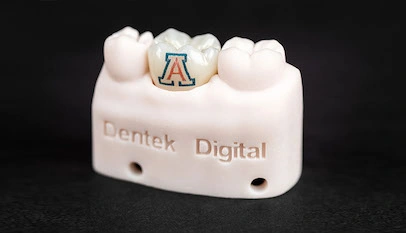
Dentek Digital also offers an innovative service called TattooTH. This is a unique, proprietary solution that embeds a digital identifier directly into dental restorations. It is especially useful for implant-supported prosthetics.
TattooTH allows dental professionals to identify a patient’s restoration with a simple scan. This is valuable in emergency or forensic situations. Furthermore, it adds an extra layer of traceability to every prosthetic we fabricate.
This kind of innovation reflects our commitment to advancing dental technology. We are not just keeping pace with the industry — we are helping to shape it.
Why Partner With a Digital Dental Lab for Implant Cases?
Choosing the right dental lab partner is essential for implant success. However, not all labs offer the same level of digital capability. A true digital lab brings precision, speed, and consistency to every case.
At Dentek Digital, we are recognized as a national leader in digital dentistry. Our team has years of experience handling complex implant cases. Additionally, our CAD/CAM equipment is continually updated to reflect the latest advancements in the field.
Dentists in Mesa, Tempe, Chandler, and across the Greater Phoenix area trust us because we deliver. We provide restorations that fit well, look natural, and stand the test of time. Moreover, our communication is clear and our turnaround times are competitive.
Benefits of Working With Dentek Digital
Here is a quick summary of what sets our lab apart:
- Early CAD/CAM adopter — Deep digital expertise built over many years
- Full-service digital lab — Fixed restorations, removables, splints, nightguards, and implants
- Digital implant planning — Advanced pre-surgical support for complex cases
- TattooTH technology — Unique restoration identification embedded at fabrication
- Skilled technicians — Experienced professionals who review every case with care
- Consistent quality — Restorations designed and milled to precise specifications
Furthermore, we make case submission easy. Dentists can send digital files directly to our team for fast review and fabrication. Our streamlined process saves your practice time and reduces back-and-forth.
Frequently Asked Questions About Permanent Dental Implants
What makes permanent dental implants different from other tooth replacement options?
Permanent dental implants are anchored directly into the jawbone. They do not rely on adjacent teeth or removable hardware. As a result, they function and feel more like natural teeth than bridges or dentures.
How does a digital dental lab support the implant process?
The dental lab fabricates the visible restoration that attaches to the implant. This includes crowns, bridges, and full-arch prosthetics. A digital lab uses CAD/CAM technology to design and mill these restorations with high accuracy.
What materials does Dentek Digital use for implant restorations?
We work with a range of premium materials, including zirconia, lithium disilicate, PFM, and hybrid ceramics. Material selection depends on the location of the tooth, aesthetic goals, and clinical requirements. Our team helps guide the right choice for each case.
Can Dentek Digital help with full-arch implant cases?
Yes. We have extensive experience fabricating full-arch implant restorations. Additionally, our digital implant planning service supports surgeons and restorative dentists working on complex full-arch reconstructions.
How do I send a case to Dentek Digital?
Sending a case is straightforward. You can submit digital scan files and case details directly through our online portal. Our team reviews each submission carefully before beginning the design process.
Work With a Lab That Delivers Precision and Quality
Permanent dental implants are one of the most significant investments a patient makes in their oral health. Therefore, the restorations that complete those implants must meet the highest standards. Precision fabrication is not optional — it is essential.
Dentek Digital brings together advanced CAD/CAM technology and experienced dental lab technicians to deliver exactly that. We serve dentists and dental practices throughout the Greater Phoenix area, including Scottsdale, Mesa, Tempe, Gilbert, and Chandler. Our goal is simple: to help you deliver outstanding results for your patients.
If you are ready to elevate your implant cases, we are here to help. Contact Dentek Digital today to send us a case or request a consultation with our team. We look forward to partnering with your practice.