
When patients lose a tooth, they want a solution that looks and feels natural. Permanent dental implants are widely considered the gold standard for tooth replacement. They restore function, protect bone health, and blend seamlessly with natural teeth.
For dentists serving patients in areas like Pike Road, AL, understanding how implant restorations are fabricated matters. The quality of the final restoration directly affects patient outcomes. That is why so many dental professionals partner with advanced digital dental labs like Dentek Digital.
At Dentek Digital, we combine CAD/CAM technology with skilled craftsmanship. As a result, we deliver precise, high-quality implant restorations that support excellent clinical outcomes. Our lab serves dental practices across the Greater Phoenix area, including Mesa, Tempe, Chandler, and Gilbert.
What Are Permanent Dental Implants?
Permanent dental implants are titanium posts surgically placed into the jawbone. They act as artificial tooth roots. Over time, they fuse with the bone in a process called osseointegration.
Once healed, a custom-fabricated restoration is placed on top. This restoration is typically a crown, bridge, or full-arch prosthetic. The result is a stable, long-lasting tooth replacement.
Key Components of a Dental Implant
Understanding the parts of an implant helps dentists and patients make informed decisions. Each component plays a critical role in the final result.
- Implant Fixture: The titanium post placed in the jawbone.
- Abutment: The connector piece between the fixture and the restoration.
- Crown or Prosthetic: The visible, custom-fabricated restoration on top.
Furthermore, the materials and precision of each component affect durability and aesthetics. A well-designed restoration from a skilled lab makes a significant difference.
Why the Dental Lab Role Matters
Many patients focus on the surgical side of implants. However, the lab-fabricated restoration is equally important. A poorly designed crown can compromise fit, function, and longevity.
Digital dental labs use CAD/CAM technology to design and mill restorations with exceptional accuracy. This technology reduces human error and improves consistency. Additionally, it allows for faster turnaround times without sacrificing quality.
CAD/CAM Technology in Implant Restorations
CAD/CAM stands for Computer-Aided Design and Computer-Aided Manufacturing. In short, it means restorations are designed digitally and milled by precision machines. This process produces highly accurate results.
At Dentek Digital, we were among the earliest adopters of this workflow in the country. Therefore, we bring deep experience and refined processes to every case. Our Phoenix-area lab supports dental practices in communities like Scottsdale, Chandler, and beyond.
Moreover, digital workflows reduce the margin for error. Every restoration is designed to exact specifications. As a result, fit and function are consistently reliable.
Types of Implant Restorations We Fabricate
Dentek Digital fabricates a wide range of implant-supported restorations. Each type serves different clinical needs. Choosing the right restoration depends on the patient’s anatomy, bone density, and aesthetic goals.
Single-Tooth Implant Crowns
Single crowns are the most common implant restoration. They replace one missing tooth with a natural-looking cap. Additionally, they preserve the surrounding teeth by eliminating the need for a bridge.
We design each crown using precise digital scans. Then we mill them from high-strength materials like zirconia or lithium disilicate. The result is a durable, lifelike restoration.
Implant-Supported Bridges
When multiple adjacent teeth are missing, an implant-supported bridge is an excellent option. Two or more implants anchor a series of connected crowns. This approach avoids removable partial dentures entirely.
Furthermore, bridges distribute biting forces more evenly across the jaw. This helps protect remaining bone and tissue. Our lab fabricates these with the same precision we apply to single units.
Full-Arch Implant Prosthetics
Full-arch solutions like All-on-4 or All-on-X protocols restore an entire arch of teeth. A fixed prosthetic attaches to several strategically placed implants. Meanwhile, patients enjoy stable, natural-feeling teeth without adhesives or removal.
These cases require careful planning and precise fabrication. Dentek Digital also offers digital implant planning services. This advanced service helps clinicians plan placement for optimal outcomes before surgery even begins.
Digital Implant Planning: A Game Changer
Digital implant planning uses 3D imaging and software to map out implant placement virtually. This process gives clinicians a roadmap before the first incision. As a result, procedures become more predictable and efficient.
Planning tools allow for precise angulation and depth analysis. They also help identify potential anatomical challenges in advance. Therefore, surgical risk is reduced significantly.
At Dentek Digital, our implant planning services integrate seamlessly with our fabrication workflow. Consequently, the restoration is designed in harmony with the planned implant position. This end-to-end digital approach sets our lab apart from traditional dental labs.
How Digital Planning Supports Better Outcomes
When planning and fabrication align digitally, fit and function improve. There are fewer chair-side adjustments. Additionally, patients experience shorter treatment times overall.
Dental practices in Mesa, Gilbert, Tempe, and across the Greater Phoenix area benefit from this integrated approach. It simplifies complex cases and strengthens the patient experience. Moreover, it builds confidence between the clinician and the lab.
Materials Used in Permanent Implant Restorations
The choice of material affects the strength, aesthetics, and longevity of the restoration. Dentek Digital works with premium materials to ensure quality. Here are the most common options used today.
- Zirconia: Extremely strong, tooth-colored, and metal-free. It is ideal for most implant crowns and bridges.
- Lithium Disilicate: Highly aesthetic and strong. Often used for anterior restorations where appearance is a priority.
- Hybrid Materials: Combine the flexibility of composite with the strength of ceramic. Commonly used in full-arch prosthetics.
- Titanium Abutments: Durable and biocompatible. Used to connect the crown to the implant fixture precisely.
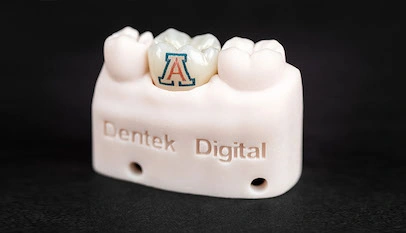
In addition, our lab also offers TattooTH, an advanced surface technology for restorations. This innovative option enhances the natural appearance and durability of certain restorations.
What Dentists Should Look for in a Dental Lab Partner
Not all dental labs are created equal. When it comes to implant restorations, the lab partner matters enormously. Here are qualities worth evaluating.
Digital Workflow Expertise
A lab that uses a fully digital workflow produces more consistent results. Look for labs with proven CAD/CAM experience. Furthermore, ask whether they offer digital implant planning services.
Turnaround Time and Communication
Timely delivery is critical in implant cases. A reliable lab communicates clearly and meets agreed-upon timelines. Additionally, they proactively flag any concerns before fabrication begins.
Material Quality and Range
Premium labs use high-quality, certified materials. They also offer a broad range of restoration options. As a result, they can accommodate diverse clinical needs across various case types.
Case Support and Collaboration
The best lab partners act as an extension of your clinical team. They provide technical guidance and case support. Moreover, they welcome collaboration on complex or atypical cases.
Frequently Asked Questions About Permanent Dental Implants
How long do permanent dental implants last?
With proper care and maintenance, implants can last many years. The longevity depends on oral hygiene, bone health, and the quality of the restoration. A well-fabricated crown from a skilled lab also extends overall durability.
What materials are best for implant crowns?
Zirconia is widely regarded as one of the best options. It is strong, aesthetic, and biocompatible. However, the best material depends on the location of the tooth and the patient’s functional demands.
Can digital labs support complex full-arch cases?
Yes. Advanced digital labs like Dentek Digital specialize in complex implant cases. We offer digital planning and full-arch fabrication. Therefore, we support clinicians from pre-surgical planning through final delivery.
How does CAD/CAM improve implant restoration quality?
CAD/CAM technology allows for precise digital design and milling. This reduces fit discrepancies and speeds up production. Additionally, it ensures every restoration meets exact clinical specifications.
What is TattooTH and how does it relate to implants?
TattooTH is an advanced surface technology offered at Dentek Digital. It enhances the aesthetic properties of certain restorations. It is especially useful for cases where natural appearance is a top priority.
Partner With Dentek Digital for Implant Restorations
Dental professionals serving patients who need permanent dental implants deserve a lab partner they can trust. Dentek Digital brings national-level expertise to every case we handle. We are proud to serve practices across the Greater Phoenix area, including communities in Mesa, Tempe, Chandler, Gilbert, and Scottsdale.
Our fully digital workflow, premium materials, and experienced team set us apart. Furthermore, our implant planning services give clinicians a powerful advantage in complex cases. We are committed to supporting better patient outcomes through precision and innovation.
If you are ready to elevate your implant restoration workflow, we are here to help. Contact Dentek Digital today to send us a case or request a consultation with our team. We look forward to partnering with you.