
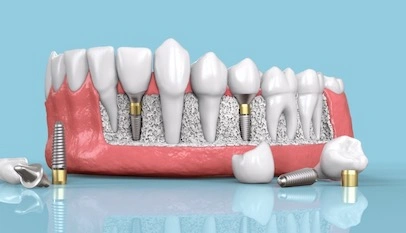
Dental implant restorations have come a long way. Today, dentists have reliable, precise options for restoring missing teeth with lasting results. Cement retained implant crowns remain one of the most widely used implant restoration approaches in modern dentistry. They offer a clean, natural appearance and a streamlined fit that many patients and clinicians prefer.
At Dentek Digital, we fabricate high-quality cement retained implant crowns using advanced CAD/CAM technology. Our digital workflow ensures precise margins, accurate fit, and consistent results. We serve dental practices across the Greater Phoenix, Arizona area, including communities in Mesa, Tempe, Chandler, and Scottsdale.
Whether you are exploring implant restoration options or refining your protocol, this guide covers what you need to know about cement retained implant crowns and how a digital dental lab can support your success.
What Are Cement Retained Implant Crowns?
Cement retained implant crowns attach to an implant abutment using dental cement. This is one of two primary implant crown retention methods. The other is screw retention. Each approach has its advantages, and the right choice depends on the clinical situation.
With cement retention, the crown fits over a custom or stock abutment. The cement bonds the crown securely in place. Therefore, the restoration looks and functions very much like a natural tooth. There is no visible access hole on the biting surface.
Key Advantages of Cement Retention
Cement retained implant crowns offer several clinical benefits. First, they allow for easier angulation correction. If the implant is placed at a suboptimal angle, a custom abutment can compensate effectively. Additionally, the occlusal surface remains intact, which supports better aesthetics.
- Natural appearance: No access hole disrupts the crown’s surface.
- Flexibility: Works well with angled implant placements.
- Passive fit: Cement can accommodate minor discrepancies in seating.
- Simplified restorative workflow: Familiar cementation steps for many clinicians.
However, cement retention does require careful technique. Excess cement must be removed thoroughly to avoid peri-implant complications. Because of this, choosing the right cement and following a meticulous protocol is essential.
How CAD/CAM Technology Elevates Implant Crown Quality
Digital fabrication has transformed what is possible in dental lab work. At Dentek Digital, we were among the earliest adopters of the CAD/CAM workflow in the country. This gives us a significant advantage in precision and consistency.
CAD/CAM stands for computer-aided design and computer-aided manufacturing. In short, digital scans replace traditional impressions. Software designs the restoration with exact specifications. Then, milling machines or 3D printers fabricate the crown from high-quality materials.
Benefits of the Digital Workflow for Cement Retained Crowns
The digital process improves outcomes at every step. For example, digital impressions eliminate distortion that can occur with traditional putty impressions. As a result, the fit of the final crown is more accurate and predictable.
- Precise margins: CAD software maps margins with exceptional accuracy.
- Consistent quality: Every restoration meets the same high standard.
- Faster turnaround: Digital files transfer instantly, reducing delays.
- Material versatility: We mill crowns from zirconia, lithium disilicate, and more.
Moreover, our team reviews each case individually. We combine technology with skilled craftsmanship. Therefore, the result reflects both digital precision and experienced human judgment.
Choosing the Right Abutment for Cement Retained Crowns
The abutment is a critical component in any implant restoration. It connects the implant fixture in the bone to the crown above the gumline. For cement retained cases, the abutment design directly affects crown fit, aesthetics, and long-term stability.
There are two main abutment types: stock and custom. Stock abutments are prefabricated. They are cost-effective and work well in straightforward cases. Custom abutments are designed digitally for a specific patient’s anatomy. They allow for better margin placement and emergence profile control.
Custom Abutments and Digital Design
At Dentek Digital, we design custom abutments digitally for each case. This approach gives clinicians greater control over the final result. Furthermore, custom abutments support healthier soft tissue contours around the restoration.
We work with a wide range of implant systems. Our team is experienced in designing cement retained solutions for cases across the Greater Phoenix area, from Scottsdale to Gilbert. Additionally, we can accommodate complex angulations and unusual anatomy with custom digital design.
Material Selection for Cement Retained Implant Crowns
Material choice plays a major role in the performance and appearance of implant crowns. Today, dental labs have access to outstanding restorative materials. Each has specific strengths depending on the clinical situation.
Zirconia
Zirconia is one of the most popular materials for implant crowns. It is extremely strong and highly resistant to fracture. Therefore, it works well in posterior regions where occlusal forces are greatest. Modern multilayer zirconia also offers excellent aesthetics.
Lithium Disilicate
Lithium disilicate, commonly known by the brand name e.max, delivers outstanding translucency and natural appearance. It is an excellent choice for anterior restorations where aesthetics are the priority. However, it requires careful occlusal design in high-load areas.
Hybrid Ceramics and PFM
In some cases, hybrid ceramic materials or porcelain-fused-to-metal (PFM) restorations may be appropriate. Our team evaluates each case and recommends the best material for the clinical conditions. Additionally, we guide clinicians through material selection when needed.
Clinical Protocols That Support Success
Even the highest quality crown requires a sound clinical protocol to succeed long-term. For cement retained implant crowns, a few key steps make a significant difference in outcomes.
Cement Selection and Technique
Choosing the right cement is important. Temporary cements allow for retrievability if needed. Permanent cements offer stronger retention but make crown removal more difficult. Many clinicians prefer a medium-strength cement that balances retention and retrievability.
Furthermore, controlling excess cement is critical. Subgingival cement remnants are a known risk factor for peri-implant disease. Therefore, techniques such as placing cement in the crown rather than on the abutment can help minimize excess.
Occlusal Considerations
Implant crowns do not have a periodontal ligament. As a result, they lack the natural shock-absorbing mechanism of natural teeth. This means occlusal design must be carefully managed. Light occlusal contact in centric and excursive movements protects the restoration and the implant.
Our team at Dentek Digital designs occlusal anatomy with these considerations in mind. We collaborate with clinicians in Mesa, Chandler, and throughout the Phoenix metro to ensure each case is designed for long-term function.
Why Partner with a Digital Dental Lab?
Not all dental labs are equal. A digital lab brings capabilities that traditional labs simply cannot match. At Dentek Digital, our fully digital workflow means fewer errors, faster delivery, and consistently excellent results.
We serve dental practices across the Greater Phoenix area, including communities in Tempe, Gilbert, Scottsdale, and beyond. Our team understands the demands of modern dental practice. Therefore, we work hard to be a reliable partner, not just a vendor.
In addition to implant crowns, we offer a full range of fixed and removable restorations, splints, nightguards, and advanced services like TattooTH and digital implant planning. This means your practice can streamline its lab relationships and work with one trusted team.
Frequently Asked Questions About Cement Retained Implant Crowns
What is the difference between cement retained and screw retained implant crowns?
Cement retained crowns attach using dental cement over an abutment. Screw retained crowns attach directly with a screw through the crown’s occlusal surface. Both are effective. The best choice depends on implant angulation, location, and the clinician’s preference.
Are cement retained implant crowns retrievable?
Retrieval is possible but can be challenging with permanent cement. Using a medium-strength or temporary cement improves retrievability. However, the crown may still need to be sectioned in some cases. Planning for retrievability during case design is always wise.
How long do cement retained implant crowns typically last?
With proper case planning, good oral hygiene, and sound occlusal design, implant crowns can last for many years. Longevity depends on material choice, cement selection, patient compliance, and the health of the surrounding tissues. We do not guarantee specific outcomes, but quality fabrication supports long-term success.
Can I send digital scans directly to Dentek Digital?
Yes. We accept digital scans from all major intraoral scanner systems. Our team processes digital files quickly and efficiently. This reduces turnaround time and eliminates the risks associated with shipping physical impressions. Contact us to confirm compatibility with your scanner.
Does Dentek Digital work with all implant systems?
We work with a wide range of implant systems and platforms. Our team has experience with many of the most commonly used systems in the Greater Phoenix area and nationally. If you have a specific system in mind, reach out and we will confirm compatibility before you submit your case.
Partner with Dentek Digital for Cement Retained Implant Crowns
Dentek Digital is a recognized national leader in digital dentistry. We combine CAD/CAM precision with hands-on craftsmanship to deliver restorations that perform and look exceptional. Our team is committed to supporting dental practices across the Phoenix metro area with reliable, high-quality lab services.
From custom abutment design to final crown fabrication, we handle every step with care. Furthermore, we are here to answer your clinical questions and help you choose the best approach for each patient. Whether your practice is in Scottsdale, Mesa, Chandler, Tempe, or anywhere in the Greater Phoenix region, we are ready to be your trusted lab partner.
Ready to elevate your implant restorations? Contact Dentek Digital today to send us a case or request a consultation with our team. We look forward to supporting your practice and your patients.