
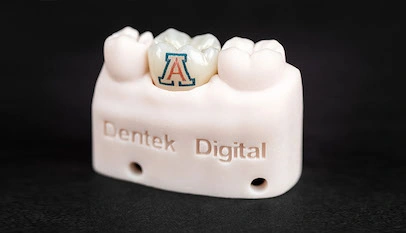
Dental splints have always required precision. However, traditional methods often introduced delays, fit issues, and extra chair time. Today, a modern digital workflow changes that completely. Dentists in Fountain Hills, AZ are discovering just how much smoother the process can be.
Because of this shift, more dental practices across the Greater Phoenix area are partnering with digital labs. They want faster turnaround, better-fitting appliances, and fewer remakes. Fortunately, that is exactly what a fully digital process delivers.
In this post, we walk through how digital workflows streamline dental splint fabrication. We also explain what dentists in Fountain Hills and surrounding communities can expect when working with a digital dental lab like Dentek Digital.
What Is a Digital Workflow in Dental Splint Fabrication?
A digital workflow replaces traditional impression materials and manual fabrication steps. Instead, it uses intraoral scanners, CAD/CAM dentistry software, and precision milling or printing equipment. The result is a highly accurate, repeatable process.
First, the dentist captures a digital scan of the patient’s dentition. Next, that scan is sent directly to the lab. Then, skilled technicians design the splint using advanced CAD software and mill or print it to exact specifications.
Moreover, every step is traceable and stored digitally. This means adjustments, remakes, or duplicates are far easier to manage. Additionally, communication between the dentist and lab becomes cleaner and faster.
How It Differs from Traditional Methods
Traditional splint fabrication relies on physical impressions. These impressions can distort, tear, or capture air bubbles. As a result, the final appliance may need several adjustments at delivery.
On the other hand, digital scans capture the full arch with exceptional detail. There is no material distortion to account for. Therefore, the fit is more predictable from the start.
Furthermore, traditional workflows require more manual steps at the lab. Each step introduces the chance for human error. Digital workflows reduce those variables significantly.
Key Benefits of a Digital Workflow for Dental Splints
Dentists in Fountain Hills, Scottsdale, Mesa, and across the Phoenix metro are seeing real advantages. A streamlined digital process benefits both the practice and the patient. Here are some of the most important ones.
Faster Turnaround Times
Digital files transmit instantly. There is no need to ship physical impressions or wait for them to arrive. Because of this, the lab can begin fabrication sooner.
Additionally, CAD/CAM milling is highly efficient. Splints can often be fabricated and shipped back to the practice in a fraction of the time. This means patients receive their appliances faster.
For busy practices in communities like Fountain Hills or Gilbert, that speed matters. It reduces the number of appointments needed and improves the overall patient experience.
Superior Fit and Accuracy
Digital scans capture precise anatomical detail. Therefore, the splint design reflects the patient’s actual bite and arch form. This leads to a better initial fit at delivery.
Moreover, CAD software allows technicians to fine-tune the design before a single piece of material is milled. Adjustments happen virtually, not physically. As a result, fewer chairside modifications are needed.
A well-fitting splint also means better patient compliance. Patients are more likely to wear an appliance that is comfortable from day one.
Consistent Quality and Reproducibility
One of the strongest advantages of a digital workflow is consistency. Every splint is fabricated using the same controlled process. Human variability is minimized at every stage.
In addition, the digital file is stored permanently. If a patient loses or damages a splint, the lab can reproduce it quickly. There is no need for a new impression or another scan in many cases.
For dental practices serving patients across Fountain Hills, Chandler, and the broader Phoenix area, that reliability builds trust. Patients and practices alike benefit from predictable outcomes.
Types of Splints Fabricated Through Digital Workflows
Digital workflows support a wide range of splint types. Each serves a different clinical purpose. However, all benefit from the precision and speed that digital fabrication offers.
Occlusal Nightguards
Occlusal nightguards protect teeth from bruxism, or nighttime grinding. They are among the most commonly prescribed dental appliances. Furthermore, they require an excellent fit to be effective and comfortable.
A digital workflow ensures the nightguard seats properly and distributes forces evenly. Additionally, the material choices available through digital fabrication have expanded significantly. Labs can mill from high-quality thermoplastic and hard acrylic materials with precision.
Anterior Deprogrammers and NTI Devices
Anterior deprogrammers help relax the jaw muscles and diagnose occlusal dysfunction. These devices require very specific fit parameters. Therefore, digital design gives technicians more control over contact points and thickness.
Additionally, NTI-style devices cover only the anterior teeth. Precise fit is critical for safety and effectiveness. A digital workflow supports that level of detail consistently.
Repositioning Splints
Repositioning splints guide the mandible into a more therapeutically favorable position. They are often used in TMJ therapy. Because of this, accuracy in design and fit is especially important.
Digital design tools allow technicians to work within exact measurements. Moreover, the dentist and lab can collaborate digitally on the intended jaw position before fabrication begins.
How the Digital Submission Process Works for Dentists
Working with a digital lab is straightforward. Many dentists in Fountain Hills and across the Phoenix metro are already equipped with intraoral scanners. The process integrates easily into most modern practice workflows.
Step One: Capture the Digital Scan
The dentist or assistant scans the patient’s upper and lower arches. They also capture a bite registration scan. Most modern scanners complete this in just a few minutes.
Additionally, the scan is immediately reviewable on screen. The team can verify accuracy before submission. This prevents errors before they reach the lab.
Step Two: Submit the Case Digitally
Once the scan is confirmed, the dentist submits the case to the lab. This includes the scan files, any relevant notes, and the prescription details. Dentek Digital accepts digital submissions and makes the process simple.
Furthermore, digital submission eliminates the risk of packages being lost or delayed in transit. The case arrives at the lab instantly. As a result, production can begin right away.
If you are ready to simplify your splint cases, contact Dentek Digital and send us your next case digitally.
Step Three: Design, Fabricate, and Deliver
Lab technicians review the scan and design the splint using CAD software. They apply the prescription parameters and optimize the fit. Then, the appliance is milled or printed using precision equipment.
After fabrication, the splint is finished, inspected, and shipped to the practice. The turnaround is typically much faster than traditional methods. Moreover, the quality remains consistent across every case.
Why Fountain Hills Dentists Choose Digital Labs
Fountain Hills is a growing community just northeast of Scottsdale. Its dental market reflects the broader trend across the Phoenix metro. Dentists here are increasingly investing in digital technology to serve their patients better.
Partnering with a digital dental lab like Dentek Digital extends that investment. The lab’s capabilities complement the practice’s scanner and digital systems. Together, they create a seamless end-to-end experience.
Additionally, proximity to Phoenix means fast local shipping. Practices in Fountain Hills, Tempe, Mesa, and Scottsdale all benefit from working with a lab based right in the Valley. Turnaround times are shorter and communication is easier.
What to Look for in a Digital Dental Lab for Splints
Not every dental lab has fully embraced the digital workflow. When evaluating a lab partner, there are a few key things to look for.
- CAD/CAM fabrication capability: The lab should design and mill or print in-house using modern equipment.
- Digital submission compatibility: The lab should accept scans from all major intraoral scanner brands.
- Material quality: Look for labs using certified, high-performance materials appropriate for splint applications.
- Transparent communication: The lab should keep you informed throughout the process and be responsive to questions.
- Proven experience: Look for a lab with a track record of delivering consistent, high-quality splints.
Dentek Digital meets all of these criteria. As one of the earliest adopters of the CAD/CAM digital workflow in the country, we bring deep expertise to every case we handle.
Frequently Asked Questions About Digital Workflows and Dental Splints
Do I need a specific intraoral scanner to work with Dentek Digital?
No. Dentek Digital accepts scan files from most major intraoral scanner platforms. If you have questions about compatibility, our team can confirm quickly. We make digital submission as easy as possible for your practice.
How does a digital splint compare in quality to a traditionally made one?
Digital splints are generally more accurate and consistent than traditionally fabricated ones. Because the design happens in CAD software, technicians can optimize every detail before milling begins. The result is a better-fitting, more reliable appliance.
Can Dentek Digital reproduce a splint if a patient loses theirs?
In most cases, yes. Because digital files are stored after fabrication, we can often reproduce a splint without requiring a new scan. This saves time for both the practice and the patient.
What types of materials are used for digitally fabricated splints?
Digital labs can mill splints from a variety of high-quality materials. Options include hard acrylic, soft thermoplastic, and dual-laminate materials. The right choice depends on the clinical indication and patient needs.
How do I get started sending splint cases to Dentek Digital?
Getting started is simple. Reach out to our team and we will walk you through the submission process. We work with practices across Fountain Hills, Scottsdale, Mesa, Chandler, and the entire Greater Phoenix area.
Partner with Dentek Digital for Your Splint Cases
A modern digital workflow makes dental splint fabrication faster, more accurate, and more reliable. Dentists across Fountain Hills and the Greater Phoenix area are already experiencing the difference. The technology is here, and the results speak for themselves.
Dentek Digital combines advanced CAD/CAM technology with skilled craftsmanship. We are proud to be a trusted lab partner for dental practices throughout Arizona. Our goal is to support better patient outcomes through precision, quality, and dependable service.
If you are ready to streamline your splint cases, we are here to help. Explore your options and reach out today. Our team is happy to answer questions, discuss your cases, and help your practice make the most of the digital workflow advantage.