
When patients lose teeth, two options come up most often: dental implants and dentures. Understanding implants vs dentures is one of the most important decisions a patient will face. As a dental professional, guiding them through that choice takes clear, reliable information.
At Dentek Digital, we fabricate high-quality dental restorations using advanced CAD/CAM technology. We support dentists and dental practices across the Greater Phoenix, Arizona area, including communities like Mesa, Chandler, Scottsdale, and Gilbert. Our team understands what it takes to deliver precise, reliable results for both implant and removable restoration cases.
This guide breaks down the key differences between implants and dentures. Additionally, it covers what dental professionals should know when planning treatment for their patients.
What Are Dental Implants?
Dental implants are titanium posts placed surgically into the jawbone. They act as artificial tooth roots. Over time, the bone fuses with the implant in a process called osseointegration.
Once the implant integrates, a dental crown, bridge, or implant-supported prosthetic is attached. Because of this, implants provide a stable, fixed foundation for the final restoration. They closely mimic the look, feel, and function of natural teeth.
Types of Implant Restorations
Implant restorations come in several forms. Each one serves a different clinical need. Here are the most common options:
- Single-tooth implant crowns – Replace one missing tooth with a crown on a single implant post.
- Implant-supported bridges – Span multiple missing teeth using implants as anchors instead of natural teeth.
- Implant-supported dentures – Full arch prosthetics that snap onto or are fixed to implant posts for added stability.
- All-on-X restorations – Full arch fixed restorations supported by a small number of strategically placed implants.
At Dentek Digital, we fabricate all of these restoration types. Furthermore, we offer advanced digital implant planning services to help dental teams prepare cases with confidence.
What Are Dentures?
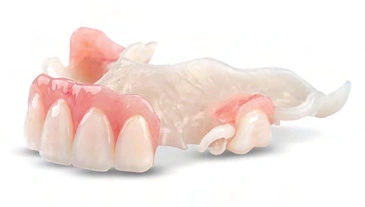
Dentures are removable prosthetics that replace missing teeth. They rest on the gum tissue and, in some cases, the underlying bone. Traditional dentures rely on suction, adhesive, or clasps for retention.
Dentures are a well-established solution. They are often more accessible for patients who are not candidates for surgery. However, they do require adjustments over time as the jawbone changes shape.
Types of Dentures
Not all dentures are the same. There are several types available depending on the patient’s clinical situation:
- Full dentures – Replace all teeth on the upper or lower arch, or both.
- Partial dentures – Fill gaps when some natural teeth remain. They attach with clasps or precision attachments.
- Immediate dentures – Placed the same day as extractions. They serve as a temporary solution during healing.
- Implant-retained dentures – A hybrid option. They use implants for retention but are still removable for cleaning.
Dentek Digital fabricates high-precision removable prosthetics using digital workflows. As a result, fit, comfort, and esthetics are consistently elevated compared to traditional analog methods.
Implants vs Dentures: Key Differences
Choosing between implants and dentures involves several important factors. Therefore, it helps to compare them side by side across the most relevant categories.
Stability and Function
Implants are fixed in the jaw. They do not move during eating or speaking. On the other hand, traditional dentures can shift, especially on the lower arch.
Implant-supported restorations generally allow patients to eat a wider variety of foods. Moreover, they eliminate the worry of prosthetic movement in social situations. This has a meaningful impact on patient confidence and quality of life.
Bone Preservation
When teeth are lost, the jawbone begins to resorb over time. Implants stimulate the bone similarly to natural tooth roots. Because of this, they help slow or prevent bone loss in many patients.
Dentures, however, do not provide this stimulation. Additionally, the pressure from a denture resting on the gums can accelerate bone resorption in some cases. This is why dentures often need relining or replacement as the bone changes.
Maintenance and Care
Implant crowns and bridges are cared for like natural teeth. Patients brush and floss normally. However, specific interdental cleaning tools may be recommended around implant restorations.
Dentures require daily removal and cleaning. They should be stored in water or a cleaning solution overnight. Furthermore, adhesives and denture cleaners are often part of the daily routine.
Timeline and Treatment Process
Implant treatment takes time. The surgical phase, healing period, and restoration fabrication can span several months. Meanwhile, dentures can often be delivered in a much shorter timeframe.
For patients who need immediate results, dentures or temporary implant restorations may be the better short-term option. Then, once healing is complete, the final implant restoration can be placed.
Patient Candidacy
Not every patient is a candidate for implants. Sufficient bone volume, healthy gums, and overall medical health are important factors. In contrast, dentures are suitable for a broader range of patients.
Patients with significant bone loss, uncontrolled systemic conditions, or other risk factors may not qualify for implant surgery. Therefore, a thorough evaluation is always necessary before recommending one option over the other.
The Role of Digital Technology in Both Solutions
Digital dentistry has transformed how both implants and dentures are planned and fabricated. CAD/CAM technology allows dental labs to design restorations with exceptional precision. As a result, fit and esthetics are significantly improved compared to traditional methods.
Dentek Digital was one of the earliest adopters of the digital CAD/CAM workflow in the country. We use this technology for implant crowns, bridges, full arch restorations, and removable prosthetics. Our digital workflow reduces errors and supports better outcomes for dental teams and their patients.
Digital Implant Planning
One of our most advanced services is digital implant planning. This process uses detailed imaging and software to map out the precise placement of implants before surgery begins. Furthermore, it allows the lab and the dental team to collaborate closely on the final restoration design from the very start.
Practices across the Greater Phoenix area, from Scottsdale to Gilbert to Mesa, use our digital implant planning service. It helps them place implants more predictably and restore cases with greater confidence.
Precision Removable Prosthetics
Our digital workflow also elevates the quality of dentures and partial dentures. We use digital design tools to achieve precise fit and natural esthetics. Additionally, our TattooTH service allows for personalized tooth characterization that makes removable prosthetics look remarkably lifelike.
Dental practices in Chandler and Tempe rely on our removable prosthetics for their patients who are not implant candidates. We deliver consistent quality on every case, no matter the complexity.
Frequently Asked Questions: Implants vs Dentures
Are implants always better than dentures?
Not necessarily. Implants offer significant functional and long-term benefits. However, they are not right for every patient. Dentures are an excellent solution for patients who are not surgical candidates or who prefer a non-surgical option. The best choice depends on the individual patient’s clinical situation and goals.
Can a patient switch from dentures to implants later?
In many cases, yes. However, bone loss that occurs while wearing dentures can complicate implant placement. Therefore, earlier evaluation is generally better. Bone grafting may be needed to restore adequate volume before implants can be placed.
How long do implants and dentures last?
With proper care, implants can last for many years. The crown or restoration on top may need replacement over time due to normal wear. Dentures typically require replacement or adjustment every several years as the bone and gum tissue change. Digital restorations from Dentek Digital are fabricated to the highest quality standards to support long-term durability.
What is an implant-supported denture?
An implant-supported denture combines the benefits of both options. Implants are placed in the jaw to provide retention. The denture snaps onto or is fixed to these implants. As a result, patients get far greater stability than a traditional denture provides while still having a removable or fixed full-arch option.
How does a digital dental lab support implant and denture cases?
A digital dental lab like Dentek Digital plays a central role in the outcome of both implant and denture cases. We use CAD/CAM technology to design and fabricate restorations with exceptional precision. Moreover, we collaborate with dental teams on planning, design, and material selection to ensure the best possible result for every patient.
Partner with Dentek Digital for Implant and Denture Cases
Whether your practice focuses on implant restorations, removable prosthetics, or both, Dentek Digital is ready to support your team. We combine advanced digital technology with skilled craftsmanship to deliver restorations that perform and look exceptional.
We serve dental practices across the Greater Phoenix area, including Mesa, Scottsdale, Chandler, Gilbert, and Tempe. Our team is experienced with the full range of implant and removable restoration cases. Furthermore, we offer digital implant planning to help your team prepare and execute complex cases with confidence.
If you are ready to elevate the quality of your implant and denture restorations, contact Dentek Digital today and let us support your next case from design to delivery.