
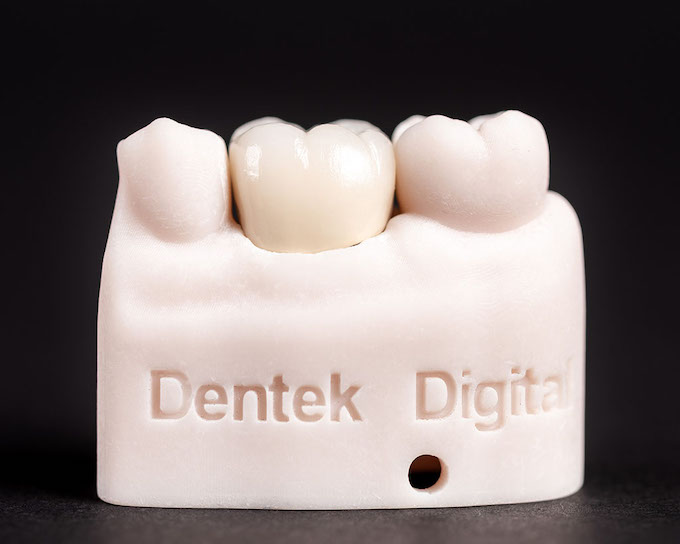
When patients face tooth loss, one of the biggest decisions they encounter is choosing between implants vs dentures. Both options can restore function and improve confidence. However, they differ significantly in how they work, how they feel, and how they are made.
For dental practices across the Greater Phoenix area — from Scottsdale to Chandler — understanding these differences helps you guide patients toward the right solution. Additionally, knowing how your dental lab fabricates these restorations gives you a real clinical edge.
At Dentek Digital, we are a digital dental lab based in Phoenix, Arizona. We specialize in high-quality CAD/CAM dental restorations for dentists and dental practices. Therefore, this guide offers a detailed, education-first look at both options from a lab perspective.
What Are Dental Implants?
Dental implants are titanium posts surgically placed into the jawbone. They act as artificial tooth roots. As a result, they provide a stable foundation for crowns, bridges, or full-arch restorations.
Because of this stability, implants closely mimic the feel and function of natural teeth. They do not slip, shift, or require adhesives. Furthermore, they help preserve bone density over time — a critical long-term benefit.
How Implants Are Fabricated at a Digital Lab
Modern implant restorations rely heavily on digital workflows. First, your practice submits digital scans and implant data. Then, our team uses advanced CAD/CAM technology to design the restoration with precision.
Next, we mill or print the restoration using premium materials. Finally, skilled lab technicians finish and quality-check every piece before it ships. This process ensures a precise fit and a natural aesthetic outcome.
At Dentek Digital, we also offer advanced digital implant planning services. This helps dental practices in Mesa, Tempe, Gilbert, and across the Phoenix metro plan cases with greater accuracy before surgery begins.
What Are Dentures?
Dentures are removable appliances that replace missing teeth. They rest on the gum tissue and, in some cases, rely on the palate for support. Traditional dentures have been used for generations to restore smiles.
However, modern dentures are far more advanced than their predecessors. Digital dentures, for example, are designed using CAD/CAM software and milled from high-quality acrylic or composite materials. As a result, they offer improved fit, aesthetics, and durability.
Types of Dentures Available Today
- Full Dentures: Replace an entire arch of missing teeth. They rest on the gums and are removable.
- Partial Dentures: Fill gaps when some natural teeth remain. They clip onto existing teeth for support.
- Implant-Supported Dentures: Attach to implants for added stability. They offer the comfort of implants with the coverage of dentures.
- Digital Dentures: Designed and fabricated using CAD/CAM technology. They deliver more consistent results than traditional methods.
Many dental practices in Chandler and Scottsdale are now transitioning to digital dentures. Moreover, the shift to digital workflows allows labs like Dentek Digital to deliver faster turnaround times without sacrificing quality.
Implants vs Dentures: Key Differences
Choosing between implants and dentures is rarely simple. Both solutions serve real patient needs. However, several key factors set them apart.
Stability and Comfort
Implants are fixed in the jawbone. Therefore, they feel and function much like natural teeth. Patients can eat, speak, and smile without worry.
Traditional dentures, on the other hand, can shift during eating or speaking. Furthermore, they may require adhesive creams for added retention. Implant-supported dentures bridge this gap by combining both technologies.
Bone Preservation
One of the most important long-term considerations is bone health. When a tooth is lost, the jawbone begins to resorb over time. Implants stimulate the bone just like natural tooth roots. As a result, they slow or prevent this bone loss.
Dentures do not stimulate the bone. Because of this, patients with full dentures may notice facial changes over the years as the jaw structure shifts. This is a critical point for dental professionals to communicate clearly to patients.
Maintenance and Care
Implants are maintained much like natural teeth. Patients brush, floss, and visit their dentist regularly. Additionally, no special soaking solutions or removal routines are needed.
Dentures require daily removal and cleaning. They must also be stored in water or solution overnight. However, with proper care, quality dentures can last for many years before needing replacement or relining.
Treatment Timeline
Implant treatment typically takes several months to complete. First, the implant is placed and allowed to integrate with the bone. Then, the final restoration is attached once healing is complete.
Dentures, on the other hand, can often be delivered more quickly. Furthermore, immediate dentures can be placed the same day as extractions in many cases. This makes them an appealing choice for patients who need faster results.
When Are Implants the Better Choice?
Implants are often ideal for patients who are in good general and oral health. Moreover, they work best when sufficient bone volume is present to support the post.
They are also a strong choice for patients who want a long-term, low-maintenance solution. For example, a younger patient replacing a single tooth may benefit greatly from an implant crown that can last decades with proper care.
Dental practices in Mesa and Gilbert frequently recommend implants for patients who prioritize bone health and natural function. Additionally, implant-retained restorations tend to have high patient satisfaction over the long term.
When Are Dentures the Better Choice?
Dentures remain an excellent option for many patients. They are often more accessible and can accommodate complex cases where multiple teeth are missing across both arches.
Furthermore, patients who are not candidates for surgery due to health conditions may find dentures a safer path. In addition, cost and timeline are real factors for many patients, and dentures can address both effectively.
Digital dentures, in particular, have raised the bar for what removable appliances can deliver. They offer a more precise fit and improved aesthetics compared to conventionally made dentures. As a result, patient acceptance is often much higher.
The Role of the Dental Lab in Restoration Quality
Whether you are restoring a single implant or fabricating a full-arch denture, your dental lab plays a central role in the outcome. The quality of materials, the precision of the design, and the skill of the technician all matter enormously.
At Dentek Digital, we use advanced CAD/CAM technology combined with experienced craftsmanship. Therefore, every restoration we produce meets high standards for fit, function, and aesthetics. We work with dental practices across Phoenix, Scottsdale, Tempe, and the surrounding communities.
Our Implant and Removable Solutions
Our lab offers a full range of implant restorations, including crowns, abutments, and full-arch solutions. Additionally, we fabricate high-quality digital dentures, partial dentures, and implant-supported overdentures.
We also offer TattooTH, an advanced digital denture solution that delivers exceptional aesthetics and durability. Furthermore, our digital implant planning service supports your team from case design through final restoration delivery.
Because we were one of the earliest adopters of the digital CAD/CAM workflow in the country, our team brings deep experience to every case we handle. We are proud to serve dental professionals who demand the best for their patients.
Frequently Asked Questions
Are implants always better than dentures?
Not necessarily. Implants offer significant advantages in stability and bone preservation. However, dentures are a valid and effective solution for many patients, especially when health or cost factors are involved. The best choice depends on the individual patient’s needs.
Can a patient switch from dentures to implants later?
In many cases, yes. However, the patient must have adequate bone volume to support implants. If significant bone loss has occurred, bone grafting may be required first. A thorough clinical evaluation is essential before making any decision.
What are implant-supported dentures?
Implant-supported dentures attach to implants placed in the jawbone. As a result, they offer far more stability than traditional removable dentures. They are a popular middle-ground solution for patients who want better retention without committing to individual implant crowns.
How does a digital dental lab improve restoration outcomes?
Digital labs use CAD/CAM technology to design restorations with high precision. This reduces human error and produces a more consistent fit. Furthermore, digital workflows allow for faster turnaround and easier case communication between the lab and the dental practice.
Does Dentek Digital work with practices outside of Phoenix?
Yes. While we are based in Phoenix, Arizona, we work with dental practices across the Greater Phoenix area and beyond. Our digital workflow makes it easy to collaborate with practices in Chandler, Gilbert, Mesa, Scottsdale, and other communities.
Partner With Dentek Digital for Your Implant and Denture Cases
Choosing between implants vs dentures is a decision that requires both clinical judgment and high-quality lab support. Your patients deserve restorations that fit well, look natural, and stand the test of time.
At Dentek Digital, we combine cutting-edge CAD/CAM technology with skilled craftsmanship to deliver exceptional results. Whether you are restoring a single implant or fabricating a full set of digital dentures, our team is ready to support you.
Dental practices across Phoenix, Mesa, Tempe, Scottsdale, Chandler, and Gilbert trust us to deliver precision restorations on time and to spec. We would love to be your lab partner.
Ready to get started? Contact Dentek Digital today to discuss your next case and discover how our digital lab solutions can elevate your patient outcomes.