
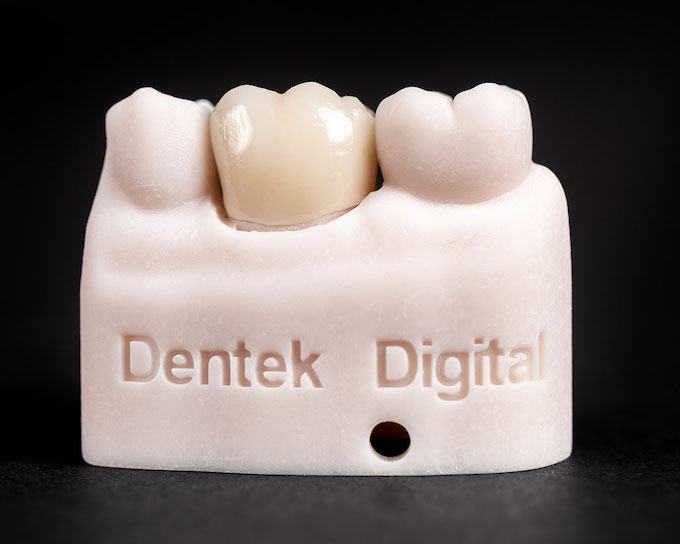
When your patients need implant restorations, the details matter. Cement retained implant crowns offer a reliable, natural-looking solution that many dentists prefer for anterior and posterior cases alike. Choosing the right restoration type can directly impact fit, aesthetics, and long-term patient satisfaction.
At Dentek Digital, we fabricate implant crowns for dental practices across the Greater Phoenix, Arizona area and beyond. Our digital CAD/CAM workflow ensures every restoration meets precise specifications before it ever reaches your operatory. We understand what dentists need — and we deliver it consistently.
Whether you’re in Chandler, Mesa, Scottsdale, or Tempe, this guide gives you a clear look at cement-retained implant crowns, how they compare to screw-retained options, and how a digital dental lab can support better outcomes for your patients.
What Are Cement-Retained Implant Crowns?
A cement-retained implant crown attaches to an abutment using dental cement. The crown itself does not have a screw access hole. Instead, it sits on top of a prefabricated or custom abutment and is cemented in place much like a traditional crown on a natural tooth.
This design gives the restoration a cleaner occlusal surface. Additionally, it allows for more natural contours and easier shade matching in aesthetic zones. Many dentists find the workflow familiar and straightforward.
Key Components of the Restoration
A cement-retained implant crown consists of two main parts: the abutment and the crown. The abutment connects directly to the implant fixture in the bone. The crown then seats over the abutment and is secured with cement.
At Dentek Digital, we fabricate both custom abutments and crowns using advanced CAD/CAM technology. Therefore, each component is designed to work together seamlessly. This integrated approach reduces the risk of poor fit and improves overall restoration quality.
Cement-Retained vs. Screw-Retained Implant Crowns
Both restoration types have real clinical value. However, the right choice depends on the patient’s anatomy, the implant position, and your clinical preference. Understanding the differences helps you make more confident treatment decisions.
Advantages of Cement-Retained Crowns
- No screw access hole — preserves occlusal surface integrity
- More aesthetic options — ideal for visible anterior zones
- Familiar placement technique — similar to conventional crown cementation
- Better contour flexibility — allows natural emergence profiles
- Wider compatibility — works with many implant angulations
Furthermore, cement-retained designs often allow more flexibility when implant angulation is less than ideal. Screw-retained restorations require a more precise implant trajectory. Because of this, cement-retained crowns can be a practical solution in challenging anatomical situations.
Considerations to Keep in Mind
Cement-retained crowns do carry one important consideration. Excess cement must be carefully removed at placement to prevent peri-implant complications. On the other hand, using a proper cementation technique and a well-designed margin depth significantly reduces this risk.
Additionally, retrievability is more limited compared to screw-retained options. If a restoration needs adjustment later, removal is more involved. Therefore, thorough planning at the design stage is essential — and that is exactly where a skilled digital lab becomes your most valuable partner.
How CAD/CAM Technology Elevates the Restoration
Digital fabrication has transformed what is possible with implant restorations. At Dentek Digital, we were among the earliest adopters of the CAD/CAM workflow in the country. Today, our technology allows us to design and mill restorations with a level of accuracy that traditional methods simply cannot match.
Every cement-retained implant crown we create starts as a precise digital design. We use detailed scan data, digital impressions, and advanced software to engineer each restoration before fabrication begins. As a result, the fit, function, and aesthetics are dialed in from the very start.
Materials We Use for Implant Crowns
We work with high-performance materials suited for implant restorations. These include full-contour zirconia, layered zirconia, and PFM options depending on clinical needs. Each material offers a unique balance of strength, translucency, and durability.
Moreover, our digital workflow allows us to customize shading, contours, and occlusal morphology with precision. We combine technology with skilled craftsmanship to produce restorations that look and function naturally. Dentists across the Phoenix area trust us to get it right the first time.
Serving Dentists Across the Greater Phoenix Area
Dentek Digital proudly supports dental practices throughout the Greater Phoenix metro. We work with dentists in Scottsdale, Mesa, Tempe, Chandler, Gilbert, and surrounding communities. Our digital workflow makes it easy to collaborate remotely and deliver high-quality restorations efficiently.
We understand the pace of a busy dental practice. Therefore, we focus on clear communication, reliable turnaround times, and consistent quality. When you send us a case, you can expect precise restorations backed by experienced technicians who care about the outcome.
Our Implant Services at a Glance
- Cement-retained implant crowns
- Screw-retained implant crowns
- Custom CAD/CAM abutments
- Implant-supported bridges
- Digital implant planning support
- Full-arch implant restorations
In addition, we offer advanced services like TattooTH and digital implant planning to support more complex cases. These tools help you visualize the restoration before fabrication begins. First, we plan — then we build with precision.
Tips for Optimizing Cement-Retained Implant Crown Cases
Getting great results with cement-retained implant crowns starts before the impression is taken. Here are some practical steps to streamline the process and improve outcomes for your patients.
1. Use Digital Impressions When Possible
Digital impressions provide cleaner data and eliminate distortion from traditional impression materials. They also reduce patient discomfort and lab errors. Additionally, they integrate directly into our digital workflow for faster, more accurate design.
2. Communicate Margin Depth Clearly
Margin depth is especially important for cement-retained restorations. Subgingival margins make excess cement removal more difficult. Therefore, when possible, aim for equigingival or slightly subgingival margins and communicate this clearly with your lab.
3. Provide Complete Occlusal Information
Share bite registration data and any relevant occlusal notes with your lab. This helps us design a crown that functions properly from day one. Meanwhile, we use this data to refine the occlusal morphology in the digital design phase before milling begins.
4. Choose the Right Cement
Cement selection matters significantly for implant cases. Use a cement that allows controlled application and easy cleanup. Moreover, some dentists prefer using a provisional cement initially to verify fit and function before final cementation.
5. Plan the Abutment Profile Early
The emergence profile of the abutment directly shapes the soft tissue around the implant. A well-designed custom abutment encourages healthy tissue contours. As a result, the final restoration looks more natural and is easier to maintain long-term.
Frequently Asked Questions About Cement-Retained Implant Crowns
What is the main difference between cement-retained and screw-retained implant crowns?
Cement-retained crowns attach to an abutment using dental cement, with no screw access hole. Screw-retained crowns are secured with a screw through the occlusal surface. Both are effective — the right choice depends on implant position, anatomy, and clinical goals.
Are cement-retained implant crowns retrievable?
Retrievability is more limited with cement-retained crowns compared to screw-retained designs. However, they can be removed if necessary. Careful planning and proper cementation technique help minimize the need for retrieval in most cases.
What materials work best for cement-retained implant crowns?
Full-contour zirconia is a popular choice because of its strength and natural appearance. Layered zirconia offers enhanced aesthetics for high-visibility cases. Additionally, PFM options remain available depending on the clinical situation and patient preference.
How does a digital dental lab improve implant crown accuracy?
A digital lab uses CAD/CAM technology to design and fabricate restorations from precise scan data. This eliminates many sources of human error found in traditional workflows. Therefore, the fit, margins, and occlusion are more accurate and consistent.
How do I send an implant case to Dentek Digital?
Sending a case is simple. You can submit digital scans, impressions, or physical models along with a prescription. Our team reviews each case carefully and communicates with you throughout the process to ensure the best possible result.
Partner with Dentek Digital for Your Implant Restorations
Cement-retained implant crowns require precision at every step — from impression to delivery. At Dentek Digital, we bring together advanced CAD/CAM technology, skilled technicians, and a collaborative approach to help your practice deliver exceptional results.
We serve dental practices throughout Phoenix, Scottsdale, Mesa, Chandler, Tempe, and the surrounding Greater Phoenix area. Our team is ready to support your next implant case with the quality and accuracy you expect from a national leader in digital dentistry.
Ready to elevate your implant restorations? Contact Dentek Digital today to send us a case or request a consultation with our experienced lab team. We look forward to partnering with your practice.