
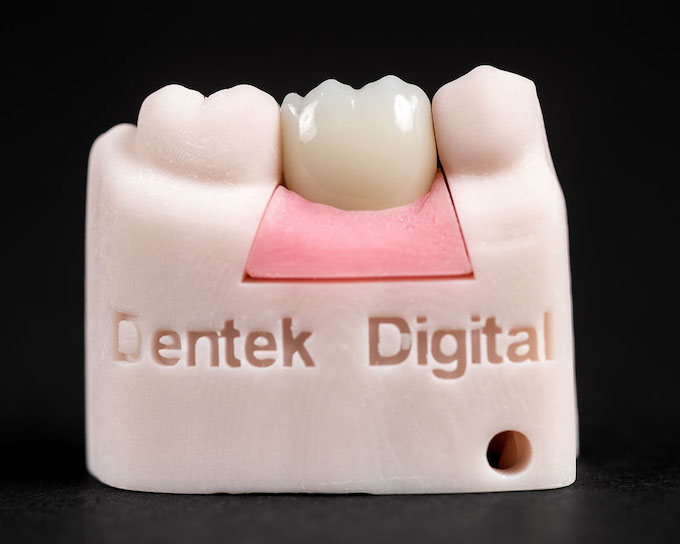
Implant placement does not always go according to plan. Sometimes the trajectory of a fixture makes a straight-screw-access crown impossible. Angled screw channel implant crowns solve that problem elegantly. They allow dentists to redirect the screw access channel so the restoration still seats and functions correctly — even when implant angulation is far from ideal.
At Dentek Digital, we fabricate angled screw channel implant crowns using a fully digital CAD/CAM workflow. We partner with dental practices across the Greater Phoenix, Arizona area — from Scottsdale to Chandler — to deliver restorations that fit precisely and perform reliably.
If you serve patients in Manhasset, NY and are evaluating lab partners who specialize in complex implant cases, this guide is for you. Below, we cover everything you need to know about this restoration type, how the digital workflow makes it possible, and how to get started.
What Are Angled Screw Channel Implant Crowns?
An angled screw channel implant crown is a screw-retained crown that uses a redirected access channel. Instead of the screw hole exiting through the center of the occlusal surface, the channel is angled — often up to 25 degrees or more — to exit in a more favorable position.
This is especially useful in the anterior region. For example, a labially placed implant may otherwise require a screw hole that exits through the facial surface. Because of this, an angled screw channel becomes the restorative solution that preserves both function and aesthetics.
How the Screw Channel Gets Redirected
The redirection is made possible by a specialized titanium base component with a built-in angled channel. The crown is then designed digitally to match the angulation of that base. As a result, the screw can still be accessed and tightened from a functional position — without compromising the restoration’s appearance.
This is not a workaround. It is a well-established, clinically proven technique used routinely in modern digital implant dentistry.
Screw-Retained vs. Cement-Retained Implant Crowns
Many dentists still use cement-retained crowns in certain cases. However, screw-retained restorations offer distinct advantages. They are retrievable, which means you can remove and re-access them easily if needed. Additionally, they eliminate the risk of residual cement irritating peri-implant tissues.
Angled screw channel crowns extend those benefits to cases where screw retention previously seemed impractical. Therefore, more implant cases can now be handled with a retrievable restoration.
Why Digital CAD/CAM Technology Makes a Difference
Fabricating angled screw channel implant crowns requires precision at every step. Traditional analog methods make this difficult. In contrast, digital CAD/CAM workflows allow technicians to design the screw channel redirection with accuracy and repeatability.
At Dentek Digital, we were among the earliest adopters of the digital CAD/CAM workflow in the country. We use advanced design software to model each crown individually. Furthermore, our milling and manufacturing processes are calibrated to tight tolerances that analog labs simply cannot match.
The Digital Workflow Step by Step
- Digital scan or impression: You submit a digital scan or a physical impression of the implant position and surrounding tissue.
- Virtual design: Our technicians design the crown in CAD software, accounting for the angulation of the screw channel.
- Titanium base selection: We select the appropriate angled titanium base compatible with your implant system.
- Milling or printing: The crown is fabricated from a high-quality material block using our CAM milling equipment.
- Finishing and quality check: Each restoration is finished, inspected, and verified before shipment.
This workflow is both efficient and consistent. Moreover, it produces restorations that arrive ready to seat with minimal chairside adjustment.
Material Options for Angled Screw Channel Crowns
Material selection depends on the location of the implant and the patient’s functional demands. Common options include full-contour zirconia, layered zirconia, and PFM on a titanium base. Each material has trade-offs in terms of strength, aesthetics, and cost. Therefore, we work with you to choose the best option for each specific case.
In anterior cases — where appearance is critical — layered or high-translucency zirconia tends to deliver the most lifelike results. In posterior cases, full-contour zirconia offers excellent durability and is easier to maintain.
Clinical Scenarios Where Angled Screw Channel Crowns Excel
Not every implant case requires an angled screw channel. However, several clinical situations make this restoration type the clear choice.
Labially Tilted Implants in the Anterior Region
When an anterior implant is placed with a slight labial trajectory — due to bone anatomy or surgical access — a standard screw channel would exit through the facial surface. This is cosmetically unacceptable. An angled screw channel redirects access to the lingual or cingulum area, preserving the crown’s aesthetic surface.
Posterior Implants with Limited Occlusal Space
In some posterior cases, the screw access channel exits in a position that interferes with the occlusion. By angling the channel, the access point can be repositioned slightly to avoid contact points and maintain a stable bite.
Cases with Compromised Bone Volume
Sometimes bone volume or adjacent structures dictate an implant angulation that is less than ideal from a restorative standpoint. In these situations, an angled screw channel implant crown allows the restorative dentist to work with — rather than fight against — the surgical outcome.
What Dentists Should Know Before Submitting a Case
Preparation makes the fabrication process much smoother. First, confirm the implant system and the implant position before submitting a case. Next, provide a clear digital scan or polyvinyl siloxane impression. Then include the implant system name, implant size, and the degree of angulation if known.
Additionally, communicating shade and material preferences upfront saves time. Our team reviews every case before fabrication begins. If we have questions, we will reach out before proceeding — not after the crown is already built.
Compatible Implant Systems
We work with a wide range of major implant systems. Most leading manufacturers offer angled titanium base components compatible with their implant lines. We can advise you on compatibility based on the system you use. However, it is always helpful to confirm the specific platform and connection type when submitting your case.
Turnaround and Logistics for Out-of-State Practices
Dentek Digital is based in Phoenix, Arizona, but we serve dental practices across the country — including those in Manhasset, NY. We ship and receive cases from out-of-state offices regularly. Our team coordinates with you on packaging, shipping timelines, and case communication. As a result, working with a Phoenix-based lab from New York is straightforward and reliable.
Practices in communities like Mesa, Tempe, Gilbert, and Chandler also rely on our lab for their most complex implant cases. That same level of service extends to every practice we work with — regardless of location.
Why Dental Practices Choose Dentek Digital for Implant Crowns
Dentek Digital is recognized as a national leader in digital dentistry. We have invested heavily in technology and talent to stay ahead of the curve. Furthermore, we bring years of hands-on experience fabricating complex implant restorations using fully digital workflows.
Our lab is built around precision. Every angled screw channel implant crown we produce is designed digitally, milled with calibrated equipment, and inspected before it leaves our facility. Additionally, we communicate clearly and promptly with every practice we serve — because your time matters.
We also offer a full range of services beyond implant crowns, including fixed restorations, removables, splints and nightguards, and advanced digital services like TattooTH and digital implant planning. Therefore, we can support multiple needs within a single lab relationship.
Frequently Asked Questions About Angled Screw Channel Implant Crowns
How much angulation can be corrected with an angled screw channel crown?
Most angled titanium base components allow for redirection in a range of approximately 17 to 25 degrees. The exact range depends on the implant system and the specific component used. Our team can help you determine whether a given case falls within a correctable range.
Are angled screw channel crowns retrievable?
Yes. One of the primary advantages of screw-retained restorations is retrievability. Angled screw channel crowns maintain that advantage. The access hole can be opened and the screw removed when necessary — for maintenance, repairs, or tissue assessment.
What implant systems are compatible with angled screw channel components?
Most major implant manufacturers — including Nobel Biocare, Straumann, Zimmer Biomet, and others — offer angled titanium base options. Compatibility varies by platform and connection type. Therefore, confirm your implant system details when submitting your case to our lab.
How do I submit an angled screw channel case to Dentek Digital?
You can submit a case through our online case submission portal. Include a digital scan or physical impression, the implant system details, shade and material preferences, and any notes about the angulation challenge. Our team reviews every case before fabrication begins.
Does the angled screw channel affect the strength of the restoration?
When designed and fabricated correctly, the angled channel does not meaningfully compromise the structural integrity of the crown. The titanium base handles the mechanical load, and the crown material is selected based on the functional demands of the specific site. Proper case design is key.
Partner With Dentek Digital for Complex Implant Cases
Angled screw channel implant crowns represent one of the most useful tools in modern restorative implant dentistry. They expand what is possible for patients with challenging implant angulations — without sacrificing aesthetics or retrievability.
At Dentek Digital, we fabricate these restorations with a fully digital workflow, precision-calibrated equipment, and experienced technicians who understand the demands of complex implant cases. We serve dental practices across the Greater Phoenix area — including Scottsdale, Chandler, Tempe, and Mesa — as well as practices nationwide, including those in Manhasset, NY.
Ready to get started? Contact Dentek Digital today to discuss your case or submit your first restoration. Our team is ready to help you deliver better outcomes for your patients.