
When patients seek permanent dental implants, they expect results that look natural, function reliably, and last for years. That expectation places enormous responsibility on the dental lab behind the restoration. At Dentek Digital, we understand that pressure — and we take it seriously every single day.
Our Phoenix, Arizona lab has been a national leader in digital dentistry since the earliest days of CAD/CAM workflows. We fabricate implant restorations with a level of precision that traditional methods simply cannot match. Furthermore, we partner closely with dental professionals to support the best possible outcomes for their patients.
Whether you are a dentist in Scottsdale, Gilbert, or Mesa looking to upgrade your implant workflow, this guide covers what you need to know. We will walk through how permanent implant restorations are made, what makes digital fabrication different, and how Dentek Digital supports your practice every step of the way.
What Makes Permanent Dental Implants Different from Other Restorations
Permanent dental implants are not like crowns or bridges placed on natural teeth. They integrate directly with the jawbone through a titanium post. As a result, the restoration sitting on top of that post — the crown or prosthetic — must meet very specific fit and performance standards.
The margin between success and failure is extremely small. Therefore, the lab that fabricates the implant crown or full-arch restoration plays a critical role. A poor fit can lead to discomfort, implant stress, or even failure over time.
Additionally, implant restorations must be designed to handle significant bite forces. They also need to blend seamlessly with surrounding teeth in shape, shade, and surface texture. This combination of functional precision and aesthetic detail is what separates a great implant restoration from a mediocre one.
Single-Unit vs. Full-Arch Implant Restorations
Single-unit implant crowns replace one missing tooth. They sit on a single implant post and must match the adjacent teeth closely. Meanwhile, full-arch restorations — such as All-on-4 or All-on-6 prosthetics — replace an entire arch of teeth supported by just a few strategically placed implants.
Both restoration types require precision engineering. However, full-arch cases are particularly complex. They involve careful planning, precise angulation data, and materials engineered to distribute force across the entire arch evenly.
At Dentek Digital, we fabricate both single-unit and full-arch implant restorations. Our digital workflow allows us to handle the complexity of each case with consistent, repeatable accuracy.
How CAD/CAM Technology Elevates Implant Restoration Quality
CAD/CAM stands for Computer-Aided Design and Computer-Aided Manufacturing. In simple terms, it means we design restorations digitally and mill or print them with automated precision. This technology has transformed what is possible in dental fabrication.
Traditional lab methods relied heavily on manual impressions and hand-sculpted wax models. Those techniques introduced variability at every step. Because of this, fit and aesthetics could vary from case to case. CAD/CAM eliminates many of those variables.
Moreover, digital workflows allow for faster turnaround times without sacrificing quality. Dental practices in Chandler, Tempe, and across the Greater Phoenix area benefit from receiving precise, well-fitting restorations on a predictable schedule.
The Digital Workflow at Dentek Digital
Our process begins when a dental practice sends us a digital scan or impression data. Next, our skilled technicians import that data into our design software. They then engineer the restoration using precise measurements drawn directly from the scan.
Once the design is approved, our milling or printing equipment fabricates the restoration from high-quality materials. Finally, our technicians inspect and finish each piece by hand before it ships. This combination of technology and craftsmanship is what defines Dentek Digital.
In addition, our team is available to consult on complex cases. We work directly with dentists to problem-solve and optimize each restoration before fabrication begins. That collaborative approach results in better outcomes for everyone involved.
Materials Used in Permanent Implant Restorations
The material used for an implant restoration directly affects its strength, appearance, and longevity. Dentek Digital works with a range of high-performance materials suited to different clinical situations.
Zirconia is one of the most commonly used materials for implant crowns. It is extremely strong, tooth-colored, and highly biocompatible. Therefore, it is an excellent choice for both anterior and posterior implant restorations.
For full-arch cases, we also work with monolithic zirconia and layered options depending on aesthetic demands. Additionally, we use materials specifically engineered for implant-retained prosthetics that must withstand long-term wear and occlusal loading.
Choosing the Right Material for Each Case
Not every case calls for the same material. On the other hand, using the wrong material for a specific clinical situation can compromise the result. That is why we encourage dentists to discuss material selection with our team before submitting a case.
Factors such as bite force, aesthetic zone placement, and opposing dentition all influence material choice. Furthermore, the implant system being used can affect which prosthetic components and materials are compatible. Our team is experienced in navigating these decisions efficiently.
- Zirconia crowns — Ideal for strength and natural aesthetics
- Monolithic zirconia — Excellent for high-force posterior cases
- Layered zirconia — Best when detailed anterior aesthetics are a priority
- PMMA provisionals — Used during healing phases before the final restoration
Digital Implant Planning: A Smarter Way to Start
One of the advanced services Dentek Digital offers is digital implant planning. This service allows dental providers to map out implant placement virtually before surgery begins. As a result, the entire treatment becomes more predictable from day one.
Digital planning uses cone beam CT scan data and intraoral scan data together. These are merged to create a three-dimensional model of the patient’s anatomy. The dentist can then visualize exactly where implants should be placed for the best functional and aesthetic outcome.
Moreover, surgical guides can be fabricated from this digital plan. These guides help the clinician place implants with exceptional accuracy during surgery. For practices in Mesa, Scottsdale, or Gilbert, this level of planning support can significantly improve case outcomes and patient satisfaction.
Why Planning Ahead Matters for Implant Success
Implant placement and restoration design are deeply connected. However, they are often treated as separate processes. When planning and design happen together from the start, the result is a restoration that fits precisely over a well-placed implant.
Additionally, digital planning reduces the risk of surgical surprises. The clinician knows before the procedure begins where nerves, bone density variations, and anatomical structures are located. Because of this, the surgical experience becomes safer and more efficient for both the dentist and the patient.
Supporting Dental Practices Across the Greater Phoenix Area
Dentek Digital is proud to serve dental professionals throughout Phoenix and the surrounding communities. We work with practices in Tempe, Chandler, Scottsdale, Gilbert, and Mesa, among many others. Our goal is to be a seamless extension of each dental team we partner with.
We offer straightforward case submission, responsive communication, and consistent turnaround times. Furthermore, our team is always available to consult on challenging cases or new implant systems. We believe that strong lab-to-practice communication is one of the most important factors in implant success.
In addition, Dentek Digital stays at the forefront of digital dentistry innovation. As technology evolves, we invest in new equipment and training so our partners always have access to the most advanced fabrication options available.
TattooTH: Advanced Digital Surface Technology
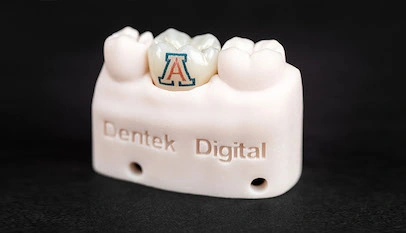
One of the unique services Dentek Digital offers is TattooTH. This advanced digital service allows for highly detailed surface characterization on restorations. It enhances the natural appearance of implant crowns by replicating the subtle surface details found on natural teeth.
For anterior implant restorations where aesthetics are critical, TattooTH can make a significant difference. Moreover, it helps restorations blend naturally with adjacent teeth in a way that is difficult to achieve through conventional finishing alone. It is another example of how Dentek Digital combines technology with craftsmanship.
Frequently Asked Questions About Permanent Dental Implants
What is the role of the dental lab in implant treatment?
The dental lab fabricates the crown, bridge, or full-arch prosthetic that attaches to the implant post. Therefore, the lab’s precision directly affects how well the restoration fits, functions, and looks. Choosing an experienced digital lab like Dentek Digital is essential for consistent, high-quality results.
How does a digital workflow improve implant restorations?
Digital workflows reduce variability by replacing manual impression techniques with precise scan data. As a result, restorations fit more accurately from the start. They also allow for faster design reviews and more predictable fabrication timelines.
What materials does Dentek Digital use for implant crowns?
We work with several high-quality materials including zirconia, monolithic zirconia, and layered zirconia. Material selection depends on the clinical situation, bite forces, and aesthetic goals. Our team helps dentists choose the best option for each specific case.
Can Dentek Digital help with full-arch implant cases?
Yes. We fabricate full-arch restorations for complex cases including All-on-4 and similar implant-supported prosthetics. Additionally, we offer digital implant planning support to help clinicians achieve the best possible outcomes before surgery begins.
How do dental practices in the Phoenix area submit cases to Dentek Digital?
Case submission is straightforward. Dental practices can send digital scans, prescription forms, and case details directly through our submission process. Our team reviews each case and follows up quickly to confirm details or ask clarifying questions before fabrication begins.
Partner with Dentek Digital for Implant Restorations That Perform
Permanent dental implants represent one of the most significant investments a patient makes in their oral health. The restoration quality matters enormously. Therefore, the dental lab you choose to fabricate that restoration should be one you can trust completely.
Dentek Digital brings together advanced CAD/CAM technology, experienced technicians, and a genuine commitment to quality. We serve dental professionals throughout Phoenix, Scottsdale, Mesa, Tempe, Chandler, Gilbert, and beyond. Furthermore, we are always looking for new partnerships with practices that demand the best for their patients.
Ready to elevate your implant workflow? Contact Dentek Digital today to discuss your next case or explore how our digital implant solutions can support your practice. We look forward to working with you.