
Full mouth dental implants represent one of the most transformative solutions in modern restorative dentistry. They restore a patient’s smile, function, and confidence in ways that traditional dentures simply cannot match. Because of this, more dental practices are turning to advanced digital labs to meet growing patient demand.
At Dentek Digital, we fabricate high-quality implant restorations for dentists and dental practices across the Greater Phoenix, Arizona area. Our CAD/CAM-driven workflow helps clinicians deliver precise, reliable results for even their most complex full-arch cases. Therefore, understanding the lab side of this process is essential for any practice expanding their implant services.
Whether you serve patients in Mesa, Tempe, Chandler, or Gilbert, this guide walks you through the digital lab process behind full mouth dental implants. You will learn what goes into fabricating these restorations, what to look for in a lab partner, and how digital technology elevates every step.
What Are Full Mouth Dental Implants?
Full mouth dental implants replace an entire arch — or both arches — of missing teeth. They anchor to implant fixtures placed in the jawbone. This creates a stable, long-lasting foundation for a fixed or removable prosthesis.
Unlike traditional dentures, implant-supported restorations do not slip or shift. Additionally, they help preserve the jawbone by mimicking natural tooth roots. This makes them a preferred solution for patients with significant tooth loss.
Common Full-Arch Implant Approaches
Dental practices typically use a few well-established approaches for full-arch implant cases. Each has unique lab requirements. Here are the most common options:
- All-on-4 or All-on-X: A fixed full-arch prosthesis supported by four or more implants. This is one of the most popular approaches today.
- Implant-Supported Overdenture: A removable prosthesis that snaps onto implant attachments for added stability.
- Full-Arch Fixed Bridge: A multi-unit bridge spanning an entire arch, secured to multiple implants.
- Zirconia Full-Arch Prosthesis: A monolithic or layered zirconia restoration known for strength and esthetics.
Each approach requires precise lab fabrication. Moreover, the materials and design choices directly affect clinical outcomes and patient satisfaction.
The Role of the Digital Dental Lab
The dental lab plays a critical role in every full mouth implant case. First, the lab receives scan data or physical impressions from the clinician. Then, skilled technicians use CAD/CAM software to design the restoration digitally.
At Dentek Digital, we were among the earliest adopters of the digital CAD/CAM workflow in the country. As a result, our team has deep experience with complex full-arch cases. We use advanced milling and 3D printing technology to produce restorations with exceptional fit and esthetics.
CAD/CAM Design and Milling
CAD/CAM stands for Computer-Aided Design and Computer-Aided Manufacturing. In simple terms, it means we design your restoration on-screen and mill it from a high-quality material block. This process delivers consistency that handcraft alone cannot always achieve.
Furthermore, digital design allows for precise adjustments before any material is cut. This reduces remakes and improves turnaround time for your practice. Ultimately, your patients spend less time waiting for their final restoration.
Material Selection for Full-Arch Cases
Choosing the right material is one of the most important decisions in a full-arch implant case. Therefore, your lab partner should guide you through the options based on your patient’s needs and your clinical plan.
Common materials for full mouth implant restorations include:
- Zirconia: Extremely strong and highly esthetic. It works well for both anterior and posterior restorations.
- PMMA (Acrylic): Often used for provisional restorations during the healing phase.
- Titanium Frameworks: Used as a substructure under layered acrylic or ceramic in some full-arch designs.
- Hybrid Ceramics: Offer a balance of strength and shock absorption, especially useful in full-arch cases.
Additionally, the occlusal design matters just as much as the material. Our technicians carefully engineer every case to support proper bite function and long-term durability.
Digital Implant Planning: A Game-Changer
One of the most valuable services a digital lab offers is implant planning support. At Dentek Digital, we provide advanced digital implant planning as part of our service offering. This helps clinicians place implants in the most prosthetically ideal positions.
Because of this planning-first approach, the final restoration fits more predictably. It also streamlines the surgical and restorative phases. As a result, your practice can deliver a smoother patient experience from start to finish.
How Digital Planning Works
Digital implant planning starts with a CBCT scan and an intraoral scan or digital impression. Our team overlays these files to create a three-dimensional view of the patient’s anatomy. Then, we collaborate with the clinician to plan implant positions that support the ideal prosthetic outcome.
This process also allows for the creation of surgical guides. These guides help the surgeon place implants with greater precision. Moreover, they reduce chair time and improve consistency across cases.
Working with a Phoenix-Area Digital Lab
Dental practices in the Greater Phoenix area benefit from working with a local digital lab that understands their patient base. Our team at Dentek Digital serves clinicians across Phoenix, Scottsdale, Chandler, Mesa, and surrounding communities.
Local partnership means faster communication and quicker turnaround on complex cases. Furthermore, our team is available to consult on case design, material selection, and troubleshooting when you need it most. You are not just sending a case to a distant lab — you are working with a nearby team that is invested in your success.
What Practices Can Expect from Our Lab
When you partner with Dentek Digital, you can expect a consistent, high-quality experience on every case. Here is what that looks like in practice:
- Digital case submission: Send scans and case details through our streamlined submission process.
- Design review: Our technicians review every case and communicate proactively if questions arise.
- Precision fabrication: We mill and finish every restoration using advanced CAD/CAM equipment.
- Quality checks: Each restoration passes multiple quality checkpoints before it ships.
- Reliable turnaround: We respect your schedule and your patients’ expectations.
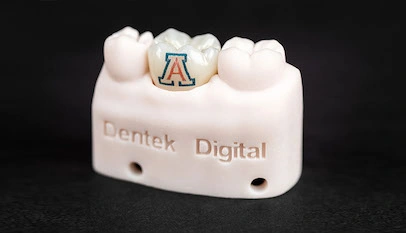
In addition, we offer TattooTH, our proprietary marking system that helps identify dental prosthetics discreetly. This is especially useful for full-arch cases and patients with complex care needs.
Tips for Sending Full-Arch Implant Cases to Your Lab
A successful full mouth implant restoration starts with a well-organized case submission. Therefore, following a few best practices makes a real difference in your outcomes.
Best Practices for Case Submission
- Use high-quality digital scans: Accurate intraoral scans reduce the need for adjustments at delivery.
- Include a complete prescription: Specify materials, shade, occlusal scheme, and any special instructions.
- Share CBCT data for planned cases: This supports accurate digital implant planning.
- Communicate implant system details: Include the brand, connection type, and angulation of all implants.
- Provide photos when possible: Facial and smile photos help our technicians optimize esthetics.
Moreover, open communication with your lab throughout the case helps prevent surprises at delivery. Our team welcomes questions and collaboration at every stage.
Frequently Asked Questions About Full Mouth Dental Implants and Lab Fabrication
What information does the lab need to fabricate a full-arch implant restoration?
The lab needs accurate scan files, a complete case prescription, implant system details, and shade or esthetic preferences. Additionally, photos and digital implant planning data are helpful for complex cases.
How long does it take to fabricate a full-arch implant restoration?
Turnaround time varies based on complexity, material, and case design. However, digital workflows typically allow for faster fabrication compared to traditional methods. Your lab can give you a specific timeline when you submit the case.
What is the difference between a provisional and a final full-arch restoration?
A provisional restoration is a temporary prosthesis worn during the healing phase after implant placement. It is typically made from PMMA or acrylic. The final restoration is fabricated from a more durable material, such as zirconia, after osseointegration is confirmed.
Can the lab support both the provisional and final stages of a full-arch case?
Yes. At Dentek Digital, we fabricate both provisional and final restorations. Furthermore, we can coordinate the design of both stages to ensure a smooth transition and consistent esthetics throughout the process.
Does digital planning really improve implant outcomes?
Digital planning helps clinicians position implants more precisely based on the planned prosthetic outcome. As a result, the final restoration tends to fit more predictably. While no process guarantees specific results, a well-planned case generally performs better than one without pre-surgical coordination.
Partner with Dentek Digital for Full-Arch Implant Cases
Full mouth dental implants are among the most rewarding — and most demanding — cases a dental practice can take on. Therefore, choosing the right lab partner is one of the most important decisions you will make. The quality of your restorations directly affects your patients’ outcomes and your practice’s reputation.
Dentek Digital combines cutting-edge CAD/CAM technology with skilled, experienced craftsmanship. We serve dental practices across Phoenix, Mesa, Scottsdale, Gilbert, Tempe, and the surrounding Greater Phoenix area. Our team is ready to support your next full-arch implant case from planning through delivery.
Ready to elevate your implant restorations? Contact Dentek Digital today to send us a case or discuss your next full-arch implant restoration with our team.