
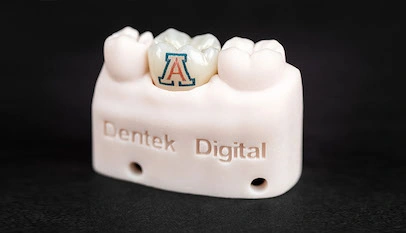
Precision is everything in dentistry. A restoration that fits poorly causes discomfort, reduces longevity, and undermines patient trust. That is why dental 3D printers have become one of the most exciting tools in the modern dental lab. They allow labs like Dentek Digital to produce restorations with a level of accuracy that was simply not possible a generation ago.
As one of the earliest adopters of the digital CAD/CAM workflow in the country, Dentek Digital has watched this technology evolve firsthand. We serve dentists and dental practices across Phoenix, Scottsdale, Mesa, Chandler, and the broader Greater Phoenix area. Therefore, we understand what accuracy in 3D printing actually means for real patients in real practices.
In this post, we break down how modern dental 3D printers achieve exceptional accuracy, what factors influence their performance, and why this matters for your practice and your patients.
What Does Accuracy Mean in Dental 3D Printing?
Accuracy in dental 3D printing refers to how closely a printed object matches its intended digital design. In clinical terms, this affects how well a restoration seats, seals, and functions in a patient’s mouth. A highly accurate printer produces fewer remakes, less chairside adjustment, and better outcomes overall.
However, accuracy is not a single measurement. It involves two related concepts that are worth understanding.
Trueness vs. Precision
Trueness describes how close the printed result is to the original digital model. Precision describes how consistently the printer reproduces that result across multiple prints. Both matter. A printer that is precise but not true will consistently produce the wrong shape. A printer that is true but not precise will produce unpredictable results.
Modern dental 3D printers are designed to achieve both. Furthermore, advances in resin chemistry, build platform engineering, and calibration software have pushed performance to impressive levels across the industry.
How Accuracy Is Measured
Labs and manufacturers assess accuracy by comparing printed objects to their reference designs using tools such as 3D scanners and specialized metrology software. Results are typically described in microns. For context, a human hair is roughly 70 microns wide. Today’s leading dental 3D printers routinely achieve deviations well within clinically acceptable ranges for most restoration types.
Additionally, independent testing organizations and dental schools regularly evaluate these systems. The findings consistently show that today’s high-quality dental 3D printers perform at a level appropriate for a wide range of clinical applications.
Technologies Behind High-Accuracy Dental 3D Printing
Not all 3D printers use the same technology. In dentistry, several printing methods have emerged. Each one approaches accuracy differently, and understanding these differences helps practices make informed decisions about their lab partners.
DLP and MSLA Printing
Digital Light Processing (DLP) and Masked Stereolithography (MSLA) are two of the most widely used technologies in dental labs today. Both methods cure liquid resin using light projected across an entire layer at once. As a result, they tend to be fast and consistent.
DLP systems use a digital projector to expose each layer. MSLA systems use an LCD screen as a mask over a UV light source. Both deliver excellent resolution and dimensional accuracy when properly calibrated. Moreover, they are well-suited for producing surgical guides, splints, nightguards, and model work.
SLA Printing
Stereolithography (SLA) uses a laser to trace each layer of the design point by point. This process tends to produce very fine detail and high surface quality. Therefore, it is often favored for applications where surface smoothness is critical. However, SLA printing can be slower than DLP or MSLA for larger print volumes.
Resin Material Quality
The printer itself is only part of the equation. Resin materials play a major role in determining final accuracy. High-quality dental resins are engineered to minimize shrinkage during curing. Shrinkage is one of the primary sources of dimensional error in 3D-printed restorations.
Additionally, resins must maintain their dimensional stability after post-curing. Labs that use validated, dental-grade resins from reputable manufacturers consistently produce more accurate results. At Dentek Digital, we are committed to using materials that meet the standards our referring dentists and their patients deserve.
Factors That Influence Print Accuracy
Even the best printer can underperform without the right conditions and processes in place. Several variables influence the final accuracy of a dental 3D-printed restoration.
Calibration and Maintenance
Regular calibration is essential. Over time, light sources degrade, build platforms shift, and mechanical components wear. A well-maintained printer will consistently outperform a neglected one. Therefore, professional dental labs invest in routine calibration schedules and quality checks.
At Dentek Digital, our team monitors printer performance on an ongoing basis. This discipline is part of what allows us to deliver reliable results to practices across Phoenix and surrounding communities like Gilbert and Tempe.
Digital File Quality
Garbage in, garbage out. The accuracy of a printed restoration can only be as good as the digital file it comes from. A high-quality intraoral scan, properly processed and designed through skilled CAD/CAM dentistry software, gives the printer the best possible starting point.
This is one reason why the full digital workflow matters so much. From scan to design to print, every step needs to be executed carefully. A weak link anywhere in the chain reduces the final result. Furthermore, experienced lab technicians who understand the nuances of digital design can catch potential issues before they reach the printer.
Orientation and Support Structures
How a file is positioned on the build platform affects accuracy. Certain orientations minimize stress and distortion during printing. Support structures, which hold the object in place during the build, also need careful placement. Poor orientation or support strategy can introduce warping or inaccuracies even on an excellent printer.
Skilled dental lab technicians understand these variables. They apply their knowledge to every case, ensuring that the final printed object meets clinical requirements. This blend of technology and craftsmanship is central to what Dentek Digital delivers.
Clinical Applications Where Accuracy Is Critical
3D printing is now used across a wide range of dental applications. However, the accuracy requirements vary depending on the restoration type. Understanding this helps practices appreciate where printing excels and where milling or other methods may be preferred.
Surgical Guides and Implant Planning
Surgical guides may be the most accuracy-sensitive application in dental 3D printing. A guide that is even slightly off can affect implant placement and long-term outcomes. Modern dental 3D printers, combined with precise digital implant planning, produce guides that dentists can trust.
Dentek Digital offers advanced digital implant planning services. We work closely with referring practices in Phoenix, Scottsdale, and Mesa to ensure that guides are fabricated with the precision that implant cases demand. Contact Dentek Digital today to discuss how we can support your next implant case.
Splints and Nightguards
Occlusal splints and nightguards require accurate fits to be effective. A device that rocks or leaves gaps will not protect the patient’s dentition properly. 3D-printed splints produced with validated resins and well-calibrated printers consistently achieve excellent fit quality.
Additionally, 3D printing allows for faster turnaround times than traditional fabrication methods. This benefits both the practice and the patient. Dentists serving patients in busy communities like Chandler and Gilbert appreciate the efficiency that digital workflows provide.
Models and Diagnostic Setups
Printed models are widely used in restorative planning, orthodontics, and patient communication. Accuracy here supports reliable treatment planning. Furthermore, high-quality models allow lab technicians to verify restorations before delivery, adding another layer of quality control.
How Dentek Digital Maintains Accuracy Standards
Accuracy is not accidental. It is the result of deliberate processes, quality materials, skilled people, and continuous investment in technology. Dentek Digital has built its reputation as a national leader in digital dentistry by taking each of these seriously.
We combine rapidly evolving technology with skilled craftsmanship. Our team brings deep expertise to every case, whether it is a single printed surgical guide or a complex full-arch restoration. Moreover, we stay current with advances in resin technology, printer calibration, and digital design software.
Our commitment to quality extends to every practice we serve across the Greater Phoenix area. We understand the trust that dentists place in their lab partners. Therefore, we work hard to earn and maintain that trust on every case we receive.
Explore your options by reaching out to our team. We are happy to walk you through our workflows and answer your questions about what digital fabrication can do for your practice.
Frequently Asked Questions About Dental 3D Printer Accuracy
Are dental 3D printers accurate enough for permanent restorations?
Today’s high-quality dental 3D printers achieve accuracy levels appropriate for many types of restorations. However, the suitability of printed restorations depends on the material, the application, and the printer used. Your dental lab can advise on which fabrication method best suits each case type.
How does 3D printing accuracy compare to milling?
Both methods can achieve excellent accuracy when properly executed. Milling is often preferred for certain materials like zirconia or high-strength ceramics. On the other hand, 3D printing excels in speed, material variety, and geometric complexity. Many modern labs use both methods to match the best approach to each case.
What role does the intraoral scan play in print accuracy?
The scan is the foundation of the entire digital workflow. A high-quality, accurate scan gives the design software and the printer the best possible data to work from. Therefore, scan quality directly affects the final fit and function of the printed restoration.
Does post-curing affect the accuracy of printed restorations?
Yes. Post-curing is a critical step in dental 3D printing. Proper post-curing ensures that the resin reaches its intended mechanical properties and dimensional stability. Inconsistent post-curing can introduce distortion. Professional dental labs follow validated post-curing protocols to minimize this risk.
Can printed restorations be used for implant-supported cases?
Printed surgical guides are widely used in implant cases and have become a standard of care in many practices. Additionally, some printed provisional restorations are used in implant workflows. However, final implant-supported restorations are typically fabricated from milled or cast materials for long-term durability.
Partner with a Lab That Prioritizes Accuracy
Modern dental 3D printers are remarkable tools. However, their accuracy depends on the expertise, processes, and commitment of the lab using them. Dentek Digital brings all of these together for practices across Phoenix, Scottsdale, Mesa, Chandler, Gilbert, and Tempe.
We are proud to be recognized as a national leader in digital dentistry. We were among the first labs in the country to embrace the full digital CAD/CAM workflow. Today, we continue to push forward, offering advanced services including digital implant planning, TattooTH, and a full range of fixed and removable restorations.
If you are ready to experience what a truly digital lab partner can do for your practice, we would love to hear from you. Send us a case and discover the Dentek Digital difference for yourself.