
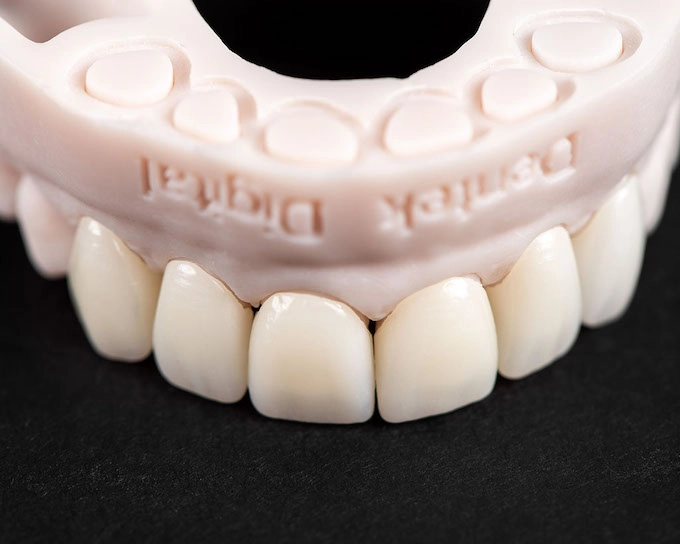
Every great dental restoration starts with precise planning. One of the most important — and often overlooked — aspects of that planning is the emergence profile. This term describes the contour of a tooth or restoration as it transitions from the implant or margin to the visible crown surface. When done right, it supports healthy gum tissue and a natural-looking result.
However, getting the emergence profile right has historically been a manual, time-intensive process. Today, digital workflows are changing that completely. CAD/CAM technology gives dental labs and clinicians far more control, consistency, and precision than traditional methods ever could.
At Dentek Digital, we work with dentists across Phoenix, Scottsdale, Mesa, and the broader Greater Phoenix area to deliver restorations built with these digital advantages. In this post, we break down how optimizing the emergence profile digitally leads to better outcomes for dentists and their patients.
What Is an Emergence Profile and Why Does It Matter?
The emergence profile refers to the shape of a tooth — or restoration — as it exits the gingival tissue. Think of it as the “angle of departure” from the gum line. A well-designed emergence profile looks natural, supports soft tissue health, and helps maintain proper hygiene.
Furthermore, a poorly designed profile can create food traps, pressure on the tissue, or gingival recession over time. These problems are difficult to reverse after placement. Therefore, getting the emergence profile right during the design phase matters enormously.
Emergence Profiles in Fixed Restorations
For crowns and bridges, the emergence profile directly affects how the restoration blends with natural tissue. Additionally, it influences the patient’s ability to keep the area clean. A profile that is too flat or too convex creates challenges for both hygiene and aesthetics.
Meanwhile, a well-contoured restoration maintains gentle tissue support and allows normal hygiene tools to reach the margin. This is especially important in anterior cases, where cosmetic results are a priority.
Emergence Profiles in Implant Restorations
In implant cases, the emergence profile becomes even more critical. Because there is no natural root structure, the restoration must recreate the natural transition from implant to crown. The shape of the abutment and crown work together to guide tissue health and esthetics.
As a result, a poorly shaped implant emergence profile can lead to tissue inflammation or an unnatural appearance. Digital design allows technicians to carefully sculpt this transition with great precision.
How Digital CAD/CAM Technology Improves Emergence Profile Design
CAD/CAM dentistry has transformed how dental labs approach emergence profile design. Digital workflows give technicians precise 3D control over every contour and angle. This level of control is simply not achievable with traditional wax-up methods alone.
Moreover, digital design software allows technicians to visualize how a restoration will interact with surrounding tissue before fabrication begins. This means problems can be caught and corrected early in the process.
3D Scanning and Digital Impressions
First, accurate data is everything. High-quality intraoral scans give the lab a precise digital model to work from. Therefore, the foundation of a great emergence profile starts with a clean, detailed scan.
When dentists in Chandler, Gilbert, or Tempe send us accurate digital impressions, our technicians can begin designing right away. Additionally, we can identify potential issues with the gingival margin before any milling or printing occurs.
Software-Driven Contour Control
Next, our team uses advanced dental design software to sculpt the emergence profile with precision. We can adjust the subgingival contour, the transition angle, and the overall shape of the restoration in real time. In addition, we can compare our design against natural tooth libraries to ensure a lifelike result.
Furthermore, digital design makes it easy to document and replicate successful profiles. For example, if a patient had a previous restoration with excellent tissue response, we can reference that design on future cases.
Milling and Material Precision
Finally, even the best digital design must be fabricated accurately. Our CAD/CAM milling equipment produces restorations with very tight tolerances. As a result, the final crown or abutment closely matches the designed emergence profile — not an approximation of it.
This level of material precision is one of the key reasons digital labs consistently outperform traditional methods in contour accuracy.
Common Emergence Profile Challenges and How We Solve Them
Not every case arrives at the lab perfectly set up for an ideal emergence profile. However, digital workflows give us more tools to work with when conditions are less than ideal.
Insufficient Tissue Depth
Some cases involve shallow tissue depth, which limits the room available for an ideal subgingival contour. In these situations, we communicate directly with the referring dentist. Because of this collaborative approach, we can recommend minor adjustments before fabrication that lead to better long-term outcomes.
Dentists in Scottsdale and Mesa who partner with us appreciate this open communication. We treat every case as a team effort, not just a manufacturing order.
Implant Angulation Issues
Implant placement angle directly affects how the emergence profile can be designed. On the other hand, digital tools allow us to compensate for angulation variations that would have been difficult to manage in a traditional workflow. Custom abutment design gives us the flexibility to optimize the emergence even in challenging placements.
Tissue Inflammation at Scan Time
Sometimes, tissue is slightly inflamed when the scan is taken. Therefore, the emergence profile must account for likely tissue settling after treatment. Our technicians use clinical knowledge and digital design tools together to anticipate these changes and build restorations accordingly.
Best Practices for Dentists Submitting Implant and Crown Cases
A great emergence profile begins long before the lab receives the case. Here are some practical steps dentists can take to set their cases up for success:
- Use a high-quality intraoral scanner and ensure the gingival margin is captured clearly in the scan.
- Provide tissue depth measurements when available — especially for implant cases.
- Include photographs of the site to give the lab visual context beyond the scan data.
- Communicate cosmetic priorities — especially in anterior cases where the emergence profile is visible.
- Share previous restoration history if the patient has had prior work in the same area.
- Flag cases with unusual implant angulation so the lab can plan accordingly from the start.
Additionally, a clear prescription with case notes helps our team understand your clinical goals. The more context we have, the better we can design the emergence profile to match your vision for the patient.
If you are ready to send a case our way, contact Dentek Digital and our team will walk you through the submission process.
Why Phoenix-Area Dentists Trust Dentek Digital for Complex Cases
Dentek Digital has been at the forefront of digital dentistry for years. We were among the earliest adopters of digital CAD/CAM workflows in the country. Moreover, we continue to invest in the latest software and milling equipment to stay ahead of the curve.
Dentists from Phoenix, Tempe, Gilbert, and Chandler rely on us for complex restorative cases that demand precision. Our team understands that emergence profile design is not just a technical detail — it is a clinical outcome that affects tissue health, patient comfort, and long-term restoration success.
Furthermore, we offer a full range of digital lab services including fixed restorations, removables, splints and nightguards, and dental implant solutions. Whether you need a single crown or a complex implant case, our CAD/CAM workflow delivers consistent, high-quality results.
Frequently Asked Questions About Digital Emergence Profile Design
What is the difference between a flat and convex emergence profile?
A flat emergence profile lacks proper tissue support and can create hygiene challenges. A convex profile, on the other hand, provides the gentle contour needed for healthy tissue response. However, an overly convex profile can place excessive pressure on tissue. Therefore, finding the right balance is the goal of digital emergence profile design.
Can CAD/CAM software accurately replicate natural emergence profiles?
Yes. Modern dental design software includes natural tooth libraries and allows technicians to sculpt highly lifelike contours. Additionally, digital tools allow for precise subgingival shaping that closely mirrors natural root anatomy. As a result, the final restoration integrates naturally with surrounding tissue.
How does emergence profile design differ for implants versus natural teeth?
For natural teeth, the emergence profile follows existing root structure. For implants, the technician must recreate that transition from scratch. Because of this, implant cases require more detailed planning and closer collaboration between the lab and the clinician.
Does the quality of the digital scan affect emergence profile accuracy?
Absolutely. The scan is the foundation of the design. A poor scan leads to guesswork, which increases the risk of an ill-fitting emergence profile. Therefore, we always encourage dentists to prioritize scan quality and retake if necessary before submitting the case.
How can I communicate my emergence profile preferences to the lab?
Include detailed notes in your case prescription. Photos, tissue depth measurements, and reference cases are all helpful. Furthermore, our team is always available to discuss complex cases before you submit. We encourage that kind of collaboration.
Partner with Dentek Digital for Precise, Digitally Designed Restorations
The emergence profile is one of the most important design elements in any crown, bridge, or implant restoration. Getting it right requires skill, technology, and clear communication between the clinician and the lab.
At Dentek Digital, we combine advanced CAD/CAM technology with experienced craftsmanship to deliver restorations that fit, function, and look natural. We serve dental practices throughout Phoenix, Scottsdale, Mesa, Chandler, Gilbert, Tempe, and the entire Greater Phoenix area.
Whether you are managing a single-unit implant crown or a complex multi-unit case, our team is ready to help. Explore your options and reach out to discuss what your next case needs — we are here to make the process simple and the results exceptional.