
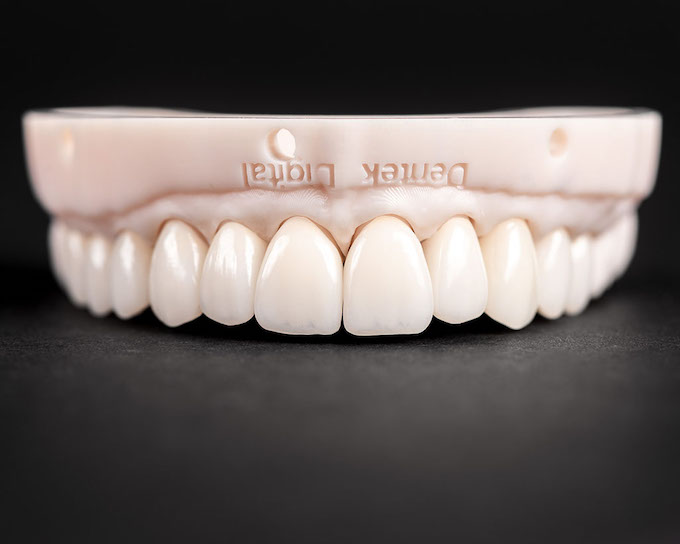
Implant-retained restorations have come a long way. Today, angled screw channel implant crowns give dental professionals a powerful solution for challenging implant positions. They eliminate the need for cement and still deliver a clean, esthetic result.
At Dentek Digital, we fabricate angled screw channel restorations using advanced CAD/CAM technology. Our digital workflow supports dentists across the Greater Phoenix area — from Scottsdale to Chandler — and dental practices nationwide, including partners as far as Scarsdale, NY.
In this post, we break down what angled screw channel implant crowns are, why they matter, and how a skilled digital lab partner makes all the difference.
What Are Angled Screw Channel Implant Crowns?
A traditional screw-retained crown requires the implant to be positioned perfectly along the occlusal axis. However, real-world implant placement does not always allow that ideal angle. That is where angled screw channel technology comes in.
Angled screw channel implant crowns use a special abutment design. The screw access channel is redirected — typically up to 25 degrees — away from the implant axis. As a result, the access hole exits through the occlusal surface rather than the facial surface of the crown.
This approach combines the benefits of screw retention with greater flexibility in implant positioning. Furthermore, it removes cement from the equation entirely, which reduces the risk of peri-implant complications.
How the Screw Channel Is Redirected
The redirection happens inside the abutment itself. A titanium insert sits within the abutment body. This insert redirects the screw path at a corrected angle. Because of this, the lab can design the crown access hole in a biomechanically sound and esthetically acceptable position.
The result is a restoration that is fully retrievable. Additionally, the occlusal access hole is small and easy to composite-seal after delivery. Most patients never notice it at all.
Why Screw Retention Matters in Implant Dentistry
Cement-retained crowns have been a standard approach for decades. However, research has consistently linked residual cement to peri-implant inflammation and bone loss. Because of this, many clinicians now prefer screw-retained restorations whenever possible.
Screw-retained crowns are also easier to retrieve. If something needs adjustment, the crown comes off cleanly. There is no cement bond to break and no risk of damaging the peri-implant tissue during removal.
When Angled Access Is the Right Call
Not every implant position allows a straight screw channel. In the posterior maxilla, for example, angulation is especially common. Also, cases with limited bone volume often result in off-axis implant placement.
In these situations, angled screw channel implant crowns offer a reliable, cement-free alternative. They allow the restorative dentist to maintain screw retention without compromising esthetics. Moreover, they expand the range of cases that can be treated with fully retrievable restorations.
The CAD/CAM Advantage in Fabricating Angled Screw Channel Crowns
Precision is everything with angled screw channel restorations. The abutment angle must be planned carefully. The crown must be designed around that redirected access channel from the very beginning. Traditional lab workflows struggle to achieve this level of accuracy.
Digital CAD/CAM technology changes that entirely. At Dentek Digital, we design every angled screw channel case in a fully digital environment. Our software lets us visualize the screw channel path, check occlusal clearance, and optimize the crown contours before we ever mill a single unit.
Digital Scanning and Design Workflow
The process starts with a precise digital scan or accurate implant-level impression. Next, we import the case into our CAD software and begin designing the custom abutment and crown as an integrated unit. We verify screw channel angulation at every step of the design.
Then, we mill the restoration from high-quality materials — typically zirconia or a titanium base with a zirconia crown. Finally, our skilled technicians finish and characterize the crown to match the patient’s natural dentition. The result is a restoration that fits precisely and functions reliably.
Material Selection for Angled Screw Channel Cases
Material choice matters in every implant restoration. For angled screw channel crowns, we commonly recommend high-strength zirconia. It offers excellent durability and supports the mechanical demands of screw-retained restorations. Additionally, modern zirconia delivers strong esthetics, especially in the anterior zone.
In some cases, a titanium base (Ti-base) abutment paired with a bonded zirconia crown is the best approach. We evaluate each case individually. Our team recommends the material combination that best fits the clinical situation and the patient’s needs.
Serving Dentists in Phoenix and Beyond
Dentek Digital is based in Phoenix, Arizona. We serve dental practices throughout the Greater Phoenix metro area, including Mesa, Tempe, Chandler, Gilbert, and Scottsdale. We are proud to be a trusted implant restoration partner for clinicians across the region.
However, our reach extends well beyond Arizona. We work with dental offices across the country — including practices in the Scarsdale, NY area — who need a reliable, digitally advanced lab partner for complex implant cases.
No matter where your practice is located, our workflow is designed for seamless remote collaboration. We guide you through the case submission process from start to finish. Moreover, our team is available to answer clinical questions and discuss case-specific details before fabrication begins.
Why Phoenix-Area Dentists Choose Dentek Digital
Dentists in Scottsdale, Chandler, and across the Phoenix metro trust Dentek Digital because of our consistency and precision. We were among the earliest adopters of digital CAD/CAM workflows in the country. That experience translates directly into better restorations for your patients.
We also offer fast turnaround times without sacrificing quality. Furthermore, our team communicates proactively throughout every case. You always know where your restoration stands in the production process.
Practical Tips for Submitting Angled Screw Channel Cases
Getting the best result from an angled screw channel restoration starts with a clean submission. Here are some practical steps to follow when sending your case to the lab.
- Use a compatible implant scan body: Make sure your intraoral scanner is calibrated and that you are using a scan body compatible with the implant system in the case.
- Capture the full emergence profile: A complete scan of the soft tissue emergence gives the lab critical information for shaping the abutment contour.
- Note the implant system and connection type: Always specify the exact implant brand, system, and connection. This ensures the correct library is used in the CAD design.
- Include opposing arch and bite registration: Accurate occlusal data is essential for designing a crown with the correct access hole position and proper contacts.
- Communicate any esthetic concerns upfront: If the case involves visible teeth or specific shade requirements, note this clearly in your case instructions.
Following these steps helps the lab produce an accurate restoration on the first attempt. Additionally, clear case notes reduce back-and-forth and speed up your turnaround time.
Frequently Asked Questions About Angled Screw Channel Implant Crowns
What angulation range is possible with angled screw channel restorations?
Most angled screw channel systems support redirection of up to approximately 25 degrees from the implant axis. However, the exact range depends on the implant system and abutment design used. Your lab can confirm compatibility for your specific case.
Are angled screw channel crowns retrievable?
Yes. One of the key advantages is full retrievability. The access hole is sealed with composite after delivery. It can be opened again if the crown ever needs to be removed for any reason.
Can angled screw channel crowns be used in the anterior region?
Yes, but careful esthetic planning is required. The access hole must exit in a location that does not compromise the facial surface. Digital CAD/CAM design helps the lab plan this precisely before fabrication begins.
How does this restoration differ from a standard implant crown?
A standard screw-retained crown requires a straight implant axis aligned with the occlusal plane. An angled screw channel crown corrects for off-axis implants. Therefore, it allows screw retention even when the implant is not ideally positioned.
What implant systems does Dentek Digital support for angled screw channel cases?
We work with a wide range of major implant systems. Contact our team directly to confirm compatibility with your specific system before submitting a case.
Partner With Dentek Digital for Your Implant Cases
Angled screw channel implant crowns are one of the most clinically valuable tools in modern restorative implant dentistry. However, they require a lab that truly understands the technology and the precision involved.
Dentek Digital has the digital infrastructure, the clinical knowledge, and the skilled technicians to fabricate these restorations with confidence. We serve dental practices in Phoenix, Mesa, Gilbert, Tempe, and Scottsdale — and we proudly partner with practices nationwide, including those in the Scarsdale, NY area.
If you are ready to simplify your implant workflow and deliver better outcomes for your patients, we are here to help. Contact Dentek Digital today to discuss your next angled screw channel case or to get started with a case submission.