
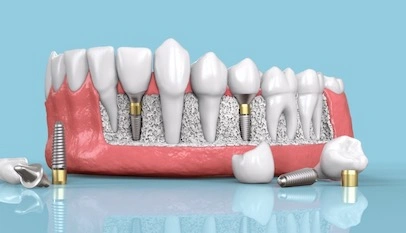
When implant placement doesn’t land in the ideal position, the restoration still needs to look and function perfectly. That’s exactly where angled screw channel implant crowns make a difference. This advanced solution allows dental labs to compensate for off-axis implant angles — delivering a screw-retained crown without sacrificing esthetics or access.
At Dentek Digital, we fabricate angled screw channel implant crowns using a fully digital CAD/CAM workflow. As a result, dentists across Phoenix and the surrounding areas receive restorations that are precise, reliable, and ready to seat with confidence.
Whether you’re restoring a single implant in a challenging position or managing a more complex case, this technology gives you more flexibility. Furthermore, it removes the compromises that traditional cement-retained crowns sometimes require.
What Are Angled Screw Channel Implant Crowns?
A standard screw-retained implant crown requires the screw access hole to align with the implant’s long axis. However, implants aren’t always placed at the perfect angle. In these situations, the access hole can end up on the facial surface — which creates an esthetic problem.
Angled screw channel implant crowns solve this issue. They use a specially angled channel to redirect the screw access. As a result, the opening lands in a more favorable position, typically on the occlusal or lingual surface.
How the Angled Channel Works
The angled channel is built into the crown structure itself. It redirects the path of the prosthetic screw by a set number of degrees — often anywhere from a few degrees up to around 25 to 30 degrees. Because of this, the screw can still be tightened securely, even when the implant isn’t perfectly vertical.
This design maintains the benefits of a screw-retained restoration. Additionally, it avoids the complications that come with cement — such as excess cement below the gumline, which can be difficult to remove and may affect tissue health.
Who Benefits Most from This Design?
Dentists working with patients who had limited bone volume or anatomy constraints often benefit most. Moreover, cases involving implants placed near anatomical limitations — like the sinus or the nerve canal — may result in off-axis angulation. Angled screw channel crowns give practitioners a predictable path forward in these situations.
The CAD/CAM Advantage in Fabricating These Crowns
Fabricating angled screw channel implant crowns requires precision at every step. Traditional analog techniques make this difficult. Digital CAD/CAM technology, on the other hand, makes it highly accurate and repeatable.
At Dentek Digital, we were among the earliest adopters of a fully digital lab workflow in the country. Therefore, our team has deep experience with complex implant restorations. We use advanced design software to plan the channel angle precisely before fabrication begins.
Digital Scanning and Design
Everything starts with a high-quality digital scan or file from your practice. Next, our technicians use that data to design the crown digitally in three dimensions. The angled channel is engineered into the design with accuracy that analog workflows simply can’t match.
Furthermore, digital design allows us to verify fit, margin integrity, and occlusal relationships before the crown is ever milled. This step alone reduces remakes and chair time significantly.
Milling and Material Selection
Once the design is finalized, we mill the crown from high-quality materials suited to implant restorations. Zirconia is a popular choice because of its strength and esthetic potential. Additionally, we can layer or stain the restoration to match the surrounding dentition closely.
Our team in Phoenix carefully reviews every restoration before it ships. As a result, dentists receive a crown that’s ready to seat — not one that requires significant adjustment at the appointment.
Why Screw-Retained Beats Cement-Retained in Many Cases
The debate between screw-retained and cement-retained implant crowns has been ongoing in dentistry for years. However, the clinical evidence increasingly favors screw retention for long-term tissue health and retrievability.
With a screw-retained crown, the restoration can be removed if needed. For example, if a patient needs imaging, a tissue adjustment, or the implant needs to be evaluated, retrieval is straightforward. Cement-retained crowns don’t always allow for easy removal.
Eliminating the Risk of Retained Cement
Retained cement beneath the gumline is a recognized cause of peri-implant inflammation. Because of this, many practitioners prefer to avoid cement altogether in the subgingival zone. Angled screw channel crowns let you do exactly that — without compromising where the access hole ends up on the crown.
Moreover, the tissue response around screw-retained restorations tends to be favorable. Patients benefit from healthier tissue outcomes over time, which supports the long-term success of the implant.
Simpler Long-Term Maintenance
Retrievability also simplifies maintenance. Additionally, if the screw ever loosens over time, the dentist can re-torque it without destroying the restoration. This level of serviceability adds real value for both the practice and the patient.
Serving Dentists Across the Phoenix Metro Area
Dentek Digital is based in Phoenix and proudly serves dental practices throughout the Greater Phoenix area. We work closely with dentists in Scottsdale, Chandler, Gilbert, and Tempe, as well as practices across the broader region.
Our digital workflow makes collaboration easy regardless of your location. Therefore, even practices outside Arizona can send cases to our lab and receive the same level of quality and precision. We’ve built our reputation as a national leader in digital dental lab services — and every restoration we produce reflects that commitment.
Streamlined Case Submission
Sending a case to Dentek Digital is simple. First, your team captures a digital scan using your intraoral scanner. Next, you submit the case file through our easy online submission process. Then, our technicians review the case and reach out if any clarification is needed before fabrication begins.
This streamlined process saves time for your team and reduces the back-and-forth that slows down traditional lab workflows. Additionally, digital files eliminate many of the errors that can occur with physical impressions and shipping.
Tips for Sending a Successful Angled Screw Channel Case
Getting the best result from an angled screw channel implant crown starts at the practice level. Here are a few practical tips to set your case up for success:
- Use a scan body from the correct implant system. Accurate implant position data is essential for designing the channel angle correctly.
- Include detailed notes on the implant angle. Let the lab know the approximate angulation so the technician can plan the channel appropriately.
- Capture high-quality scans of opposing and adjacent teeth. This ensures accurate occlusal design and proper contact points.
- Specify your material preference. Monolithic zirconia, layered zirconia, and other materials each have advantages — communicate what matters most for the case.
- Share shade information clearly. Good shade photos or a detailed shade map help the lab match the natural dentition precisely.
Following these steps helps our team at Dentek Digital deliver a restoration that fits well and meets your clinical goals on the first try.
Frequently Asked Questions About Angled Screw Channel Implant Crowns
What degree of angulation can be corrected with this design?
The angled channel can typically accommodate implant angulations of up to around 25 to 30 degrees off-axis. However, the specific range depends on the implant system and the crown design. Our technicians evaluate each case individually to confirm what’s achievable.
Is this type of crown more difficult to fabricate?
With traditional methods, yes. However, digital CAD/CAM technology makes the process accurate and reliable. Our team has extensive experience with these restorations, so the workflow is well-established in our lab.
Can any implant system support angled screw channel crowns?
Most major implant systems are compatible with this restoration type. Additionally, some systems offer their own angled abutment options that work alongside or in place of the channeled crown design. We can advise on the best approach based on your specific implant system.
How long does fabrication typically take?
Turnaround time varies based on case complexity and current lab volume. Generally, our digital workflow allows for efficient production. Contact our team for specific turnaround expectations for your case type.
What if the fit isn’t right at the delivery appointment?
We stand behind our work. If there are fit concerns, contact us and we’ll work with you to resolve the issue. Because of this commitment to quality, our dentists trust us with their most complex implant cases.
Partner with Dentek Digital for Precision Implant Restorations
Angled screw channel implant crowns represent one of the most significant advances in implant prosthetics in recent years. They give dentists the flexibility to deliver screw-retained outcomes even when implant placement wasn’t ideal. Furthermore, they protect patients from the risks of retained cement and support better long-term tissue health.
At Dentek Digital, we combine industry-leading digital technology with skilled lab craftsmanship. Our team in Phoenix is ready to help you navigate even the most complex implant cases with confidence. We proudly serve practices in Scottsdale, Chandler, Gilbert, Tempe, and throughout Arizona and the nation.
Ready to get started? Contact Dentek Digital today to send us a case or discuss your next angled screw channel implant crown. We’re here to support your success — one precise restoration at a time.