
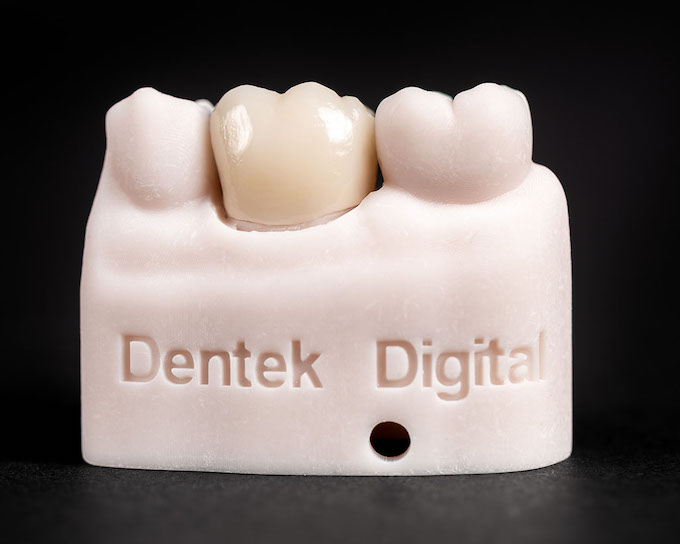
When it comes to implant restorations, dentists want solutions that combine strength, precision, and ease of retrieval. Screwmentable implant crowns deliver exactly that. They blend the best qualities of screw-retained and cement-retained crowns into one reliable restoration. As a result, they have become a go-to choice for implant cases across the country.
At Dentek Digital, we fabricate screwmentable implant crowns using advanced CAD/CAM technology. Our digital workflow allows us to produce restorations that fit precisely and perform consistently. We proudly serve dentists and dental practices throughout Greater Phoenix, including communities like Scottsdale, Chandler, Mesa, and Gilbert.
Whether you are new to screwmentable restorations or looking to refine your workflow, this guide covers what you need to know. Furthermore, it explains how partnering with a digital lab can elevate your implant outcomes.
What Are Screwmentable Implant Crowns?
Screwmentable implant crowns combine two traditional retention methods. First, the crown is screwed onto the implant abutment. Then, a small access hole is sealed with composite. This design allows the dentist to retrieve the crown if needed, while still achieving excellent esthetics.
The term “screwmentable” is a blend of “screw-retained” and “cement-retained.” In practice, the crown is bonded to a custom titanium base — often called a Ti-base — using dental cement inside the lab. Additionally, the assembly is then delivered to the dentist ready for screw placement.
How the Ti-Base System Works
A Ti-base is a small titanium component that connects to the implant. The zirconia or porcelain crown is cemented onto the Ti-base in a controlled lab environment. Therefore, there is no risk of excess cement being left around the implant margin in the patient’s mouth.
This approach is widely regarded as safer than traditional cement-retained crowns. Moreover, it eliminates one of the most common complications in implant dentistry — subgingival cement retention. The result is a cleaner, more predictable restoration for the patient.
Screw-Retained vs. Cement-Retained vs. Screwmentable
Screw-retained crowns are retrievable but can compromise esthetics due to access holes. Cement-retained crowns look great but carry the risk of cement remnants. Screwmentable crowns, on the other hand, offer retrievability without the esthetic trade-offs. Because of this, they have gained significant popularity among implant-focused practices.
Why Dentists Choose Screwmentable Restorations
Screwmentable crowns offer several clinical advantages. They give the dentist control over seating and retrieval. Additionally, they reduce the risk of biologic complications tied to excess cement. For practices focused on long-term patient outcomes, this matters greatly.
Many dentists in the Phoenix area — from Tempe to Scottsdale — have shifted toward screwmentable restorations for these reasons. Furthermore, as digital lab workflows have improved, the precision of these restorations has increased dramatically.
Esthetic and Functional Benefits
Screwmentable crowns can be fabricated in full-contour zirconia, layered zirconia, or other esthetic materials. Therefore, they meet both strength and appearance requirements across a range of cases. The lab cements the crown to the Ti-base with precision, ensuring a stable and esthetic result.
Also, because the access hole is on the occlusal or lingual surface, it can be easily sealed and polished. Most patients cannot even detect the access point after treatment. This makes screwmentable crowns an excellent choice for anterior and posterior cases alike.
Easier Maintenance and Retrieval
One of the biggest advantages of screwmentable crowns is retrievability. If a screw loosens or the crown needs adjustment, the dentist can simply unscrew it. Moreover, there is no need to cut through cemented material. This saves time and protects the integrity of the implant components.
In contrast, fully cement-retained crowns can be very difficult to remove without damaging the restoration. Because of this, many clinicians now prefer screwmentable designs as their default implant crown choice.
The CAD/CAM Advantage in Fabricating Screwmentable Crowns
Digital technology has transformed how dental labs fabricate implant restorations. At Dentek Digital, we use state-of-the-art CAD/CAM systems to design and mill every screwmentable crown with exceptional precision. This technology ensures that each restoration fits the Ti-base perfectly before it ever reaches the dentist’s chair.
Our digital workflow begins with your scan data. We accept files from all major intraoral scanners. Next, our technicians design the crown digitally using advanced software. Finally, we mill the restoration from premium-grade materials and cement it to the Ti-base in our controlled lab environment.
Digital Scanning and Case Submission
Accurate scan data is the foundation of a great screwmentable crown. We recommend capturing a scan body scan at the time of impression. Additionally, opposing arch scans and bite registration scans are essential for proper occlusal design. When we receive complete scan data, we can fabricate restorations that seat precisely and function naturally.
Dentists in Mesa, Gilbert, Chandler, and across the Greater Phoenix area send us digital cases every day. Our team reviews each file carefully before fabrication begins. As a result, we catch potential issues early and keep production on schedule.
Material Selection for Screwmentable Crowns
We offer a variety of materials for screwmentable restorations. High-strength zirconia is one of the most popular choices. It is durable, biocompatible, and esthetically versatile. However, layered zirconia or lithium disilicate may be better suited for high-esthetic anterior cases.
Our lab team can help you select the right material based on the patient’s bite, location in the arch, and esthetic goals. Furthermore, we consider the specific Ti-base system you use to ensure a precise fit between the crown and the abutment interface.
Best Practices for Sending Screwmentable Implant Cases
Successful screwmentable restorations start with thorough case preparation. Following a consistent protocol helps the lab deliver the best possible result. Below are some practical guidelines for preparing and submitting implant crown cases.
- Use a verified scan body: Confirm that your scan body is compatible with the implant system you placed. Scan body accuracy directly affects crown fit.
- Capture full arch scans: Include the implant arch, opposing arch, and bite registration. This gives us the data needed for accurate occlusal design.
- Specify the Ti-base system: Let us know the implant brand and connection type. We will select the correct Ti-base for your case.
- Include shade information: Provide shade tabs or digital shade data for esthetic consistency with adjacent teeth.
- Note any occlusal concerns: If the patient has bruxism or a heavy bite, flag this on the case form. We can adjust material selection accordingly.
Additionally, clear communication about emergence profile and gingival contours helps us deliver a crown that looks natural from day one. Therefore, including photographs or notes about soft tissue architecture is always appreciated.
How Dentek Digital Supports Implant Practices in Phoenix
Dentek Digital is one of the earliest adopters of the digital CAD/CAM workflow in the country. We were built on a commitment to precision and innovation. Our lab serves implant-focused practices throughout the Greater Phoenix area, including Scottsdale, Tempe, Mesa, Chandler, and beyond.
We understand the clinical demands of modern implant dentistry. Therefore, we engineer every restoration to meet those demands with consistency and care. Our technicians bring deep expertise in implant prosthetics and digital design. As a result, dentists trust us to handle their most complex cases.
Our Implant Restoration Offerings
In addition to screwmentable crowns, we fabricate a full range of implant restorations. These include screw-retained implant crowns, implant-supported bridges, and hybrid prostheses. We also offer digital implant planning services to support your treatment planning process.
Furthermore, our TattooTH service provides custom-shaded zirconia restorations that match natural dentition beautifully. This is especially valuable for anterior implant cases where esthetics are a top priority. Our team is ready to discuss the best solution for each unique case you send us.
Fast Turnaround and Reliable Communication
We know that your patients are counting on timely restorations. Because of this, we maintain efficient production workflows and clear communication at every step. Our team confirms receipt of your case, reviews the data, and keeps you informed throughout the fabrication process.
Also, we are always available to answer questions about case design, material selection, or delivery logistics. We treat every case as a partnership. Moreover, we are committed to helping you deliver outstanding results to every patient in your chair.
Frequently Asked Questions About Screwmentable Implant Crowns
What is the difference between a screwmentable crown and a cement-retained crown?
A cement-retained crown is bonded directly to the abutment in the mouth. A screwmentable crown is cemented to a Ti-base in the lab and then screwed into the implant. Therefore, screwmentable crowns are retrievable and eliminate the risk of intraoral cement contamination.
Can screwmentable crowns be used for anterior implants?
Yes. Screwmentable crowns work well in anterior positions when the access hole can be placed on the lingual surface. Additionally, material choices like layered zirconia or lithium disilicate provide excellent esthetics for front teeth cases.
How do I know which Ti-base to use?
The Ti-base must match the implant system and connection type you placed. When you submit your case, provide the implant brand, platform size, and connection details. Our lab will select the correct Ti-base to ensure a precise fit.
What scan data do I need to send for a screwmentable crown?
You need a scan body scan of the implant site, a full opposing arch scan, and a bite registration scan. Furthermore, including soft tissue data and photographs helps us design an optimal emergence profile.
How long does fabrication take for a screwmentable implant crown?
Turnaround times vary depending on the case complexity and material selected. However, our digital workflow is optimized for efficiency. Contact our team for current turnaround estimates and rush options if needed.
Partner with Dentek Digital for Screwmentable Implant Crowns
Screwmentable implant crowns represent one of the most significant advancements in implant prosthetics. They combine retrievability, esthetics, and clinical safety into a single, elegant solution. Moreover, when fabricated with digital precision, they deliver consistent, long-lasting results for your patients.
At Dentek Digital, we are passionate about helping dental practices achieve exceptional implant outcomes. Our team brings national-level expertise to every case we produce. Furthermore, our digital-first approach means faster turnarounds, better fits, and fewer remakes.
If you are ready to experience the difference that a true digital lab partner can make, we invite you to contact Dentek Digital and send us your next implant case. Our team is ready to support you with expert guidance, premium materials, and precise fabrication from start to finish.