
When patients lose teeth, they often face a big decision. They must choose between dental implants and dentures. Understanding implants vs dentures can help dentists guide their patients toward the best possible outcome.
This guide is designed for dental professionals seeking clear, practical information. We cover how each restoration type works, what fabrication looks like from a dental lab perspective, and how digital technology plays a major role. Whether your practice is in Phoenix, Scottsdale, Mesa, or Chandler, this resource applies to you.
At Dentek Digital, we fabricate high-quality restorations using advanced CAD/CAM technology. We work alongside dental professionals across the Greater Phoenix, Arizona area every day. Our goal is to help you deliver the best results for your patients.
What Are Dental Implants?
Dental implants are titanium posts that a surgeon places directly into the jawbone. They act as artificial tooth roots. Over time, the bone fuses around the post in a process called osseointegration.
Once the implant integrates, a dental lab fabricates a crown, bridge, or other restoration to attach on top. This creates a stable, natural-looking result. The outcome closely mimics the look and feel of a natural tooth.
How Implants Are Fabricated in a Digital Lab
Digital implant workflows have transformed how labs fabricate implant restorations. First, the dentist captures a digital scan of the patient’s mouth. Next, that scan is sent to the lab for CAD/CAM design and milling. Finally, the finished restoration is delivered with precision fit.
At Dentek Digital, we also offer advanced digital implant planning services. This helps dentists and their patients plan placement with greater accuracy. As a result, the final restoration fits more predictably from the start.
What Are Dentures?
Dentures are removable prosthetic devices that replace missing teeth. They rest on the gum tissue and, in some cases, attach to remaining natural teeth. There are two main types: full dentures and partial dentures.
Full dentures replace an entire arch of missing teeth. Partial dentures fill in gaps when some natural teeth remain. Both options restore function and appearance for patients who have experienced tooth loss.
Digital Dentures: A Modern Approach
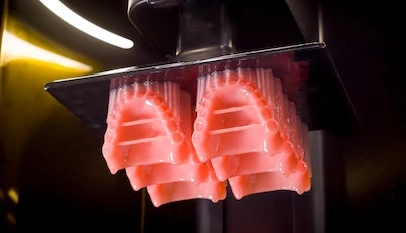
Traditional denture fabrication relied heavily on manual processes. Today, digital workflows have changed that significantly. CAD/CAM-designed dentures offer improved fit, consistency, and aesthetics.
Moreover, digital dentures can be archived digitally. This means replacements or duplicates can be fabricated more efficiently. For dental practices in Gilbert, Tempe, or anywhere in the Phoenix metro area, this is a meaningful advantage.
Dentek Digital fabricates high-quality removable prosthetics using advanced digital tools. We combine skilled craftsmanship with rapidly evolving technology. The result is a restoration that looks great and fits reliably.
Implants vs Dentures: Key Differences
Understanding the differences between these two options helps dentists counsel patients effectively. Each solution has distinct advantages depending on the patient’s clinical situation. Here is a clear side-by-side look at the key factors.
Stability and Fit
Implants are fixed in the jawbone. Therefore, they do not shift or slip during eating or speaking. Patients often find this significantly more comfortable over time.
Dentures, on the other hand, rest on the gums and may require adhesive. They can shift with movement. However, implant-supported dentures offer a hybrid solution that improves stability considerably.
Bone Health
One important clinical consideration is bone preservation. Implants stimulate the jawbone through chewing forces. Because of this, they help prevent the bone loss that typically follows tooth extraction.
Traditional dentures do not stimulate the bone in the same way. Over time, patients may experience resorption of the jaw. This can change the fit of the denture and alter facial structure.
Maintenance and Care
Implants are cared for much like natural teeth. Patients brush and floss regularly. Additionally, routine dental checkups keep them in excellent condition.
Dentures require daily removal and cleaning. They must be soaked overnight and handled with care. Furthermore, they may need periodic adjustments or relining as the jaw changes shape over time.
Treatment Timeline
Implant treatment takes longer from start to finish. The osseointegration process alone can take several months. In contrast, dentures can often be delivered in a shorter timeframe.
For some patients, this timeline difference is a deciding factor. Immediate dentures can be placed the same day teeth are extracted. Meanwhile, implant cases require careful planning and multiple appointments.
Candidacy Considerations
Not every patient is a good candidate for implants. Adequate bone density and volume are essential for successful placement. Additionally, systemic health factors can influence candidacy.
Dentures are generally accessible to a broader range of patients. They do not require surgery or bone grafting. Therefore, they remain a valuable option for many individuals.
The Role of CAD/CAM Technology in Both Restorations
Digital technology has elevated the quality of both implant restorations and dentures. CAD/CAM workflows allow for precise design, consistent fabrication, and faster turnaround. This benefits both the dentist and the patient.
At Dentek Digital, we were among the earliest adopters of digital CAD/CAM workflows in the country. We apply this expertise to every case we receive. Whether it is a single implant crown or a full-arch denture, precision is our standard.
Scanning and Digital Impressions
Digital impressions eliminate many of the challenges of traditional impression materials. They are more comfortable for patients. Furthermore, they allow labs to begin design work faster.
When your practice sends us a digital scan, our team begins the CAD design process promptly. We use advanced software to ensure ideal contours, occlusion, and aesthetics. The result is a restoration that fits the first time.
TattooTH and Advanced Lab Services
Dentek Digital also offers specialized services like TattooTH, our unique restoration identification system. This is particularly useful for denture patients. It allows for easy identification of prosthetics in care settings or emergencies.
Additionally, our digital implant planning service supports dentists before placement even begins. We help visualize the ideal implant position relative to the planned restoration. As a result, the restorative outcome is built into the plan from day one.
Choosing the Right Solution for Your Patients
There is no single right answer when it comes to implants vs dentures. The best solution depends on each patient’s unique needs, health status, and goals. Your role as the clinician is to evaluate all factors and present the options clearly.
Consider factors such as bone volume, systemic health, patient compliance, and financial considerations. Also consider the patient’s expectations and lifestyle. A thorough treatment planning conversation leads to better outcomes.
Dental practices across the Phoenix metro area — from Scottsdale to Chandler — trust Dentek Digital to support their restorative cases. We are here to help you serve your patients with the highest quality lab work available.
How Dentek Digital Supports Your Practice
We are more than a dental lab. We are a clinical partner for the practices we serve. Our team brings deep expertise in both implant restorations and removable prosthetics.
We offer a full range of solutions including fixed restorations, removables, splints, nightguards, and dental implants. Moreover, we provide advanced digital services that help practices stay ahead of the curve. Every case receives the same level of care and craftsmanship.
If your practice is ready to elevate its restorative results, we encourage you to contact Dentek Digital and send us your next case. Our team is ready to support you with precision, speed, and expertise.
Frequently Asked Questions: Implants vs Dentures
Can a patient switch from dentures to implants later?
Yes, in many cases patients can transition from dentures to implants later. However, bone loss from extended denture wear may require grafting first. A thorough clinical evaluation will determine the best path forward.
What is an implant-supported denture?
An implant-supported denture combines both technologies. Implants are placed in the jaw to anchor a removable or fixed denture. This provides significantly more stability than a traditional denture alone.
How does a digital dental lab improve implant restoration quality?
Digital labs use CAD/CAM software and precision milling to design and fabricate restorations. This improves fit accuracy compared to traditional methods. Additionally, digital records allow for efficient remakes or adjustments when needed.
How long do implant restorations last compared to dentures?
Both can last many years with proper care and maintenance. Implant crowns and bridges are generally very durable. Dentures may need relining or replacement over time as the jawbone changes.
Does Dentek Digital work with practices outside Phoenix?
Yes. While we serve the Greater Phoenix area including Mesa, Tempe, Chandler, Gilbert, and Scottsdale, we also partner with practices nationally. Our digital workflow makes it easy to collaborate with dentists regardless of location.
Partner With Dentek Digital for Your Restorative Cases
The choice between implants vs dentures is one that many patients face. As a dental professional, your guidance makes all the difference. Having a trusted lab partner ensures that whatever path you choose, the final restoration meets the highest standard.
Dentek Digital is proud to be a recognized leader in digital dentistry. We combine technology, craftsmanship, and clinical expertise to support your practice every step of the way. From digital implant planning to full-arch dentures, we have the capabilities to handle your most complex cases.
Reach out to our team today to explore how we can support your next restorative case. We look forward to partnering with your practice and helping your patients achieve outstanding outcomes.