
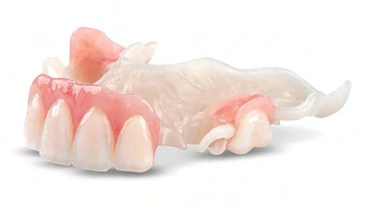
When a patient is missing teeth, the two most common restoration options are dental implants and dentures. Understanding the difference between implants vs dentures helps dental professionals recommend the right solution. Both options restore function and appearance, but they work very differently. Therefore, knowing the details matters.
At Dentek Digital, we fabricate high-quality dental restorations for dentists and practices across the Greater Phoenix area. We work with offices in Mesa, Tempe, Chandler, Scottsdale, and Gilbert every day. Our digital CAD/CAM workflow allows us to deliver precise, reliable results for both implant-supported and removable restorations.
This guide covers the key differences between implants and dentures. Additionally, it explains how digital dentistry has transformed both options. Whether your practice is just starting to offer implant restorations or expanding your removable services, this resource is for you.
What Are Dental Implants?
Dental implants are titanium posts placed directly into the jawbone. They act as artificial tooth roots. Over time, the bone fuses with the implant in a process called osseointegration. As a result, the implant becomes a stable, permanent anchor.
Once the implant integrates, a dental lab fabricates a custom crown, bridge, or other restoration. At Dentek Digital, we use advanced CAD/CAM technology to design and mill these restorations. The fit and aesthetics are highly accurate because of this digital process.
Types of Implant Restorations
Implants can support several types of restorations. First, a single crown replaces one missing tooth. Next, an implant-supported bridge replaces multiple adjacent teeth. Finally, implant-supported overdentures or full-arch restorations replace an entire arch of teeth.
Each case requires careful planning. Furthermore, digital implant planning tools allow the lab and the dentist to collaborate before treatment begins. Dentek Digital offers advanced digital implant planning services to support better outcomes for patients across Phoenix and surrounding communities.
Advantages of Dental Implants
- Bone preservation: Implants stimulate the jawbone and help prevent bone loss.
- Stability: Implant restorations do not slip or shift during eating or speaking.
- Longevity: With proper care, implants can last for many years.
- Natural feel: Patients often report that implants feel like their natural teeth.
- No adhesives needed: Implant restorations stay in place without creams or pastes.
However, implants are not right for every patient. The placement process involves surgery and a healing period. Additionally, not every patient has sufficient bone density for implants without grafting first.
What Are Dentures?
Dentures are removable prosthetic devices that replace missing teeth. They rest on the gums and, in some cases, attach to remaining natural teeth. Dentures have been a trusted tooth replacement solution for generations. Moreover, modern digital fabrication has greatly improved their quality and fit.
There are two main types of dentures: complete and partial. Complete dentures replace all teeth in an arch. Partial dentures replace several missing teeth while preserving the remaining natural ones.
How Digital Dentistry Improves Dentures
Traditional denture fabrication relied heavily on manual processes. Today, digital workflows change everything. CAD/CAM technology allows labs like Dentek Digital to design dentures with greater precision. Because of this, the fit is more consistent and predictable.
Digital dentures are milled or printed from high-quality materials. As a result, they are often more durable and better-fitting than conventionally made dentures. Practices in Chandler, Gilbert, and Scottsdale are increasingly turning to digital denture solutions for their patients.
Advantages of Dentures
- Non-surgical: Dentures do not require surgery or implant placement.
- Accessibility: They are often a more accessible option for patients who cannot undergo surgery.
- Speed: Dentures can sometimes be delivered more quickly than implant restorations.
- Adjustability: Dentures can be relined or adjusted as the mouth changes over time.
- Cost: Traditional dentures are generally a lower upfront investment than implants.
On the other hand, dentures do have limitations. They can shift during use and may require adhesives for stability. Furthermore, they do not prevent bone loss the way implants do. Over time, the fit may change as the jawbone resorbs.
Implants vs Dentures: A Side-by-Side Comparison
Choosing between implants and dentures depends on several factors. These include the patient’s health, bone density, budget, and lifestyle. Here is a simple comparison to help dental professionals guide their patients.
Stability and Function
Implants are fixed and do not move. They function much like natural teeth. Dentures, however, are removable and can shift. Implant-supported overdentures offer a middle ground. They snap onto implants for better stability while remaining removable for cleaning.
Bone Health
Implants stimulate the jawbone and help maintain its volume. Dentures, by contrast, do not stimulate the bone. Therefore, bone loss can continue over time with traditional dentures. This is an important consideration for long-term patient health.
Maintenance
Implant restorations are cleaned like natural teeth. Patients brush and floss normally. Dentures require removal for cleaning and should be soaked overnight. Additionally, dentures need periodic relining as the jaw changes shape.
Treatment Timeline
Implants require a longer treatment process. The surgical phase, healing, and restoration fabrication take several months. Dentures can often be delivered in a shorter timeframe. However, digital workflows have helped reduce turnaround times for both options.
Patient Candidacy
Not every patient qualifies for implants. Good candidates have adequate bone density and healthy gums. Patients with certain medical conditions or insufficient bone may be better suited for dentures initially. Moreover, some patients choose to start with dentures and transition to implant-supported restorations later.
How Dentek Digital Supports Both Options
Dentek Digital is one of the earliest adopters of the digital CAD/CAM workflow in the country. We bring that expertise to every case we receive. Our lab serves dental practices across Greater Phoenix, including offices in Mesa, Tempe, Scottsdale, and Chandler.
For implant cases, we offer custom crowns, bridges, full-arch restorations, and digital implant planning. For removable cases, we fabricate high-quality digital dentures and partial dentures. Additionally, we provide implant-supported overdentures for patients who want greater stability without committing to fixed implants.
Our team combines advanced technology with skilled craftsmanship. Because of this, every restoration we deliver meets a high standard of fit, function, and aesthetics. We work closely with dental professionals to support the best outcomes for their patients.
Digital Implant Planning at Dentek Digital
Digital implant planning is one of our most valuable advanced services. It allows the dentist and lab to collaborate before the case begins. Furthermore, it reduces the risk of surprises during treatment. The result is a more predictable process for both the practice and the patient.
Practices across the Greater Phoenix area use our implant planning services regularly. If your office wants to explore this option, we are ready to help.
Frequently Asked Questions: Implants vs Dentures
Can a patient switch from dentures to implants later?
Yes, in many cases a patient can transition from dentures to implants. However, bone density must be assessed first. Some patients may need bone grafting before implant placement is possible. A thorough evaluation by the treating dentist is the best starting point.
Are implant-supported dentures the same as regular implants?
No, they are different. Implant-supported dentures use a small number of implants to anchor a removable prosthesis. Traditional implants support fixed crowns or bridges. Both are excellent options, but they serve different patient needs and budgets.
How does a digital lab improve implant restorations?
Digital labs like Dentek Digital use CAD/CAM technology to design and mill restorations with high precision. As a result, the fit is more accurate and the process is more consistent. Digital workflows also allow for better communication between the lab and the dental practice.
How long does it take to receive a restoration from Dentek Digital?
Turnaround times vary depending on the type of restoration. Digital workflows allow us to work efficiently without sacrificing quality. We encourage dental practices to contact Dentek Digital directly to discuss timelines for specific cases.
Does Dentek Digital work with practices outside of Phoenix?
Our primary focus is on serving dental practices across the Greater Phoenix area, including Mesa, Tempe, Chandler, Gilbert, and Scottsdale. We are happy to discuss how we can support your practice. Reach out to our team to learn more.
Choosing the Right Restoration for Your Patients
The implants vs dentures decision is not one-size-fits-all. Every patient has unique needs, health considerations, and goals. Therefore, a thorough consultation and treatment plan are essential before making any recommendation.
As a dental professional, you play a critical role in guiding patients through this decision. Meanwhile, your lab partner plays an equally important role in delivering the restoration that brings that plan to life. Dentek Digital is here to be that partner for practices across Greater Phoenix.
We bring digital precision, skilled craftsmanship, and a commitment to quality to every case. Furthermore, we are always available to discuss complex cases and help you find the best solution for your patients. Send us a case today and experience the Dentek Digital difference.